
If you are looking at an impact driver and an impact wrench, they may look similar and both use an impact mechanism but they are designed for different types of fastening.
The simplest difference is this:
An electric impact driver typically delivers less torque and accepts smaller tool bits than an impact wrench.
An impact driver uses a 1/4-inch hex interface and is mainly designed for screws and smaller fasteners while an impact wrench uses a square-drive anvil and is designed for nuts, bolts, and higher-torque fastening (than impact driver).
DEWALT describes impact drivers as typically using a 1/4-inch hex drive while impact wrenches commonly use 3/8-inch, 1/2-inch, or larger square drives.
Both tools use rotational impacts to deliver bursts of torque when resistance increases. This can reduce the continuous reaction force felt by the operator compared with a conventional drill or ratchet applying continuous rotation.
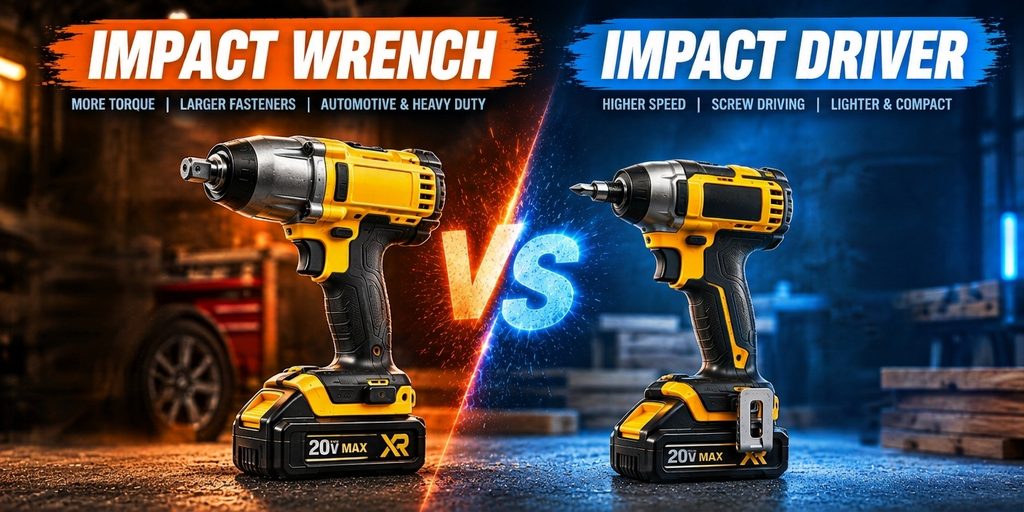
Impact Driver vs Impact Wrench: Quick Comparison
| Feature | Impact Driver | Impact Wrench |
| Primary job | Driving screws and smaller fasteners | Tightening and loosening nuts and bolts |
| Tool interface | Usually 1/4-inch hex quick-change collet | Usually square-drive anvil |
| Common drive sizes | 1/4-inch hex | 3/8-inch, 1/2-inch, 3/4-inch, 1-inch+ |
| Typical accessories | Driver bits, nut setters, impact-rated drill bits | Impact sockets and socket accessories |
| Typical applications | Decking, framing, construction, assembly | Automotive, machinery, structural fastening |
| Size | Usually compact | Ranges from compact to very large |
| Torque range | Generally lower than impact wrenches | Generally higher |
| Best for | Screws and less-resistance fasteners | Larger nuts, bolts and high-resistance fasteners |
The exact speed, torque, size, and weight vary substantially between individual models so these are general design differences rather than absolute specifications.
What Is an Impact Driver?
An impact driver is a compact power tool primarily designed for driving screws and other smaller-to-medium fasteners.
Instead of relying only on continuous motor rotation, an impact driver uses a hammer-and-anvil mechanism to produce repeated rotational impacts as resistance increases.
Most modern impact drivers use a 1/4-inch hex quick-change collet, allowing compatible driver bits and other hex-shank accessories to be installed quickly.
How Does an Impact Driver Work?
An impact driver normally starts by rotating smoothly, much like a drill. Its motor turns the internal drive mechanism, which rotates the bit and begins driving the screw or fastener.
When the fastener becomes difficult to turn, resistance increases. At this point, the impact mechanism engages. The internal hammer mechanism temporarily disengages, accelerates, and then strikes the anvil with a sudden rotational blow.
That impact transfers a short, powerful burst of torque through the 1/4-inch hex drive and into the driver bit.
The hammer then disengages and the cycle repeats rapidly:
Motor → Hammer mechanism → Anvil → 1/4-inch hex bit → Screw/smaller fastener
These repeated impacts allow the impact driver to produce substantially more fastening torque while reducing the continuous twisting force felt by the user’s hand compared with a conventional drill.
For example, DEWALT lists a 20V compact impact driver (DCF787) with a 1/4-inch hex drive, up to 2,800 RPM and 1,500 in-lb of maximum torque. These figures illustrate the high-speed, compact nature of this tool category, although specifications vary substantially between models.
What Is an Impact Driver Used For?
Common applications include:
- Driving wood screws
- Deck construction
- Fence installation
- Framing
- Cabinet and shelving installation
- Structural screws
- Self-drilling screws
- Repetitive fastening
- Construction and installation work
An impact driver’s compact head can also make it useful when working in tight spaces. Current professional models can offer multiple speed and tightening modes to give the user more control over different fasteners and materials.
What Is an Impact Wrench?
An impact wrench is a high-torque fastening and loosening tool designed primarily for nuts, bolts, and other socket-driven fasteners.
Instead of the 1/4-inch hex collet commonly found on impact drivers, impact wrenches normally use a square-drive anvil that accepts compatible sockets.
Common sizes include:
- 3/8-inch square drive
- 1/2-inch square drive
- 3/4-inch square drive
- 1-inch square drive
- Larger industrial sizes
DEWALT’s current product range includes ⅜-inch, 1/2-inch, 3/4-inch and 7/16-inch impact wrenches alongside 1/4-inch impact drivers.
How Does an Impact Wrench Work?
An impact wrench works in essentially the same way, but its mechanism is designed to deliver much higher torque to larger fasteners.
The motor first spins the internal hammer mechanism. When the nut or bolt creates enough resistance, the hammer mechanism disengages, accelerates, and strikes the anvil with a powerful rotational impact.
That impact is transferred through the wrench’s square-drive output, which holds a socket. The socket then transfers the torque directly to the nut or bolt.
The process repeats rapidly:
Motor → Hammer mechanism → Anvil → Square drive → Socket → Nut/bolt
Because the impact wrench is designed around a larger socket interface and higher torque output, it is commonly used for applications involving large bolts and nuts, such as automotive and heavy-duty fastening.
For example, current cordless impact wrenches are available in compact 3/8-inch and 1/2-inch configurations as well as much higher-output models. DEWALT’s 12V 1/2-inch DCF901B, for example, is rated at 250 ft-lb maximum tightening torque and 400 ft-lb maximum breakaway torque(Torque varies greatly by model, drive size, battery system, operating mode, and manufacturer).
What Is an Impact Wrench Used For?
Common applications include:
- Removing and installing tight/awkward nuts
- Automotive repair
- Suspension work
- Brake work
- Machinery maintenance
- Large bolts
- Structural fastening
- Heavy equipment
- Industrial maintenance
Makita describes its impact wrenches as tools designed to provide the breakaway torque needed for larger bolts and lug nuts while impact drivers to be designed to access hard-to-reach spaces.
The Biggest Difference: What Impact Driver Vs Impact Wrench Are Built to Drive
The easiest way to understand the difference is to look at the fastener and accessory you need to use.
Impact Driver
You typically put a driver bit into the 1/4-inch hex collet.
Example:
You are building a deck and need to drive hundreds of long construction screws.
Impact Wrench
You put an impact socket onto the square-drive anvil.
Example:
You need to remove stubborn nuts from a vehicle wheel.
So:
Screw & fasteners that are not seized/awkward → Impact Driver
Heavily tightened/seized fasteners → Impact Wrench
1. Drive Type: 1/4-Inch Hex vs Square Drive
One of the easiest ways to tell these tools apart is their output interface.
Impact Driver: 1/4-Inch Hex
Most impact drivers use a 1/4-inch hex quick-change collet.
This accepts compatible accessories such as:
- Phillips bits
- Torx bits
- Slotted bits
- Nut setters
- Impact-rated drill bits
- Hex-shank specialty accessories
Some impact drivers can also use socket adapters. DEWALT sells socket adapters that convert 1/4-in hex driver to 1/4-in, 3/8-in, or 1/2-in square drives.
Impact Wrench: Square Drive
Impact wrenches normally use a square-drive anvil. The socket slides directly onto the anvil.
Its natural accessories are:
- 1/4-inch impact sockets
- 3/8-inch impact sockets
- 1/2-inch impact sockets
- 3/4-inch impact sockets
- Socket extensions
- Universal joints designed for impact use
- Impact-rated adapters
Common sizes include:
| Impact Wrench Drive | Common Applications |
| 1/4-inch | Small mechanical fastening |
| 3/8-inch | Automotive and general mechanical work |
| 1/2-inch | Automotive, trucks, machinery |
| 3/4-inch | Heavy equipment and industrial work |
| 1-inch | Large industrial and heavy-duty applications |
The drive size alone does not determine the wrench’s torque. A 1/2-inch impact wrench can have very different performance from another 1/2-inch model.
2. Torque: Impact Driver vs Impact Wrench
Impact wrenches generally provide higher torque than impact drivers, particularly models designed for automotive, heavy equipment, and industrial applications.
However, there is no single torque number that separates the two categories.
Modern impact drivers can produce substantial torque. For example, Makita lists an impact driver with up to 2,040 in-lbs of maximum torque.
Impact wrenches are available in much higher-torque configurations for demanding applications.
The important point is:
Do not choose between an impact driver and impact wrench based only on the advertised torque number.
Consider:
- Fastener size
- Socket or bit interface
- Required breakaway torque
- Required tightening torque
- Material
- Access
- Tool size
- Manufacturer specifications
DEWALT notes that even a smaller impact wrench may not have enough torque to remove a seized vehicle lug nut while a larger impact wrench or breaker bar may be required.
3. Speed: Impact Driver vs Impact Wrench
It is tempting to say that an impact driver is always faster than an impact wrench, but that is not a reliable rule.
Different models have very different:
- RPM
- IPM (impacts per minute)
- Torque
- Speed settings
- Impact mechanisms
- Electronic controls
For example, current impact drivers can reach several thousand RPM, while impact wrenches can also have high rotational speeds depending on the model.
Therefore, RPM should be compared between specific models rather than used as a universal difference between the two tool categories.
For fastening, the tool’s torque, impact rate, control modes, and the fastener itself can all affect how quickly the job is completed.
4. Impact Driver vs Impact Wrench for Automotive Work
This is where many beginners become confused.
Can an Impact Driver Work on a Car?
Yes, but it depends on the job.
An impact driver can be useful for automotive work such as:
- Removing/installing screws and smaller fasteners
- Driving screws in automotive interiors
- Removing some smaller bolts
- Spinning lug nuts off after they have already been broken loose
- General light-duty automotive work
However, it isn’t a direct substitute for an impact wrench when you regularly work on:
- Lug nuts
- Suspension bolts
- Large automotive fasteners
- Rusted/stubborn bolts
- High-torque fasteners
An impact driver can remove some lug nuts if it has enough power, but an actual impact wrench is the appropriate tool for that job.
Can I use an impact driver to remove lug nuts?
Yes, technically. But there are limitations.
You can use a suitable impact-rated socket adapter and impact socket with an impact driver. The problem is that the result depends heavily on:
- How tightly the lug nuts were installed
- Whether they’re rusted/seized
- The vehicle
- The impact driver’s actual output
- Battery condition
- Socket/adapter quality
DEWALT explicitly warns that some lug nuts and bolts can require several hundred foot-pounds of force to break loose particularly when seized or heavily torqued.
The bigger issue: installing lug nuts
An impact driver is not to final-tighten lug nuts.
For example, a Chevrolet Silverado HD owner’s manual describes using an impact wrench only to snug the wheel nuts after hand-starting them, explicitly stating that the purpose is not to apply the final torque.
A torque wrench for final tightening, because an impact tool can easily exceed the vehicle manufacturer’s specified torque.
So the practical workflow is:
Removal:
Impact Driver → Normal lug nut
Impact wrench → impact-rated socket → Tighten lug nut
Installation:
Hand-start lug nut → snug carefully → torque wrench to the vehicle specification
The reason is not simply that an impact wrench is “too powerful.” The deeper issue is torque control and repeatability.
An impact wrench delivers torque through repeated impacts. The actual torque transferred to the fastener can vary with tool characteristics, battery/air supply, socket and adapter configuration, contact conditions, and operator technique.
Excessive torque can damage threads, stretch or break wheel studs, and potentially distort wheel or brake components.
Which One Is Better for DIY Automotive Work?
There is no single answer for every DIY mechanic. It depends on the jobs you actually perform.
If you mostly work on:
Interior, trim, brackets, small fasteners
→ Impact drivers can be useful.
Wheels, suspension, brakes and larger bolts
→ Impact wrench becomes much more useful.
5. Impact Driver vs Impact Wrench for Screws
If your primary job is driving screws, an impact driver is generally the more natural fit. Its 1/4-inch hex interface is designed around driver bits and fastening accessories.
An impact wrench can drive certain fasteners using appropriate adapters and sockets, but its design is centered around socket-driven fastening, not conventional screwdriver bits.
6. Which Tool Is Smaller?
In general, impact drivers are more compact than many impact wrenches, particularly compared with high-torque wrench models.
Their 1/4-inch hex interface and compact impact mechanism make them well suited to construction and installation work where access and maneuverability matter.
For example, Milwaukee lists a compact 18V impact driver at 5.1 inches in length and 1,600 in-lbs of torque.
However, impact wrenches are available in compact 12V and 18V/20V designs as well as much larger high-torque models.
Therefore:
Impact driver → generally compact
Impact wrench → available from compact to very large
Do not assume every impact driver is lighter or every impact wrench is heavy; compare the actual model specifications.
7. Cordless, Corded, and Pneumatic Impact Tools
Both impact drivers and impact wrenches are available with different power sources.
Cordless Impact Driver
Common on:
- Construction sites
- Deck building
- Framing
- Installation work
- Maintenance
Modern battery-powered impact drivers can provide substantial fastening performance while remaining compact.
Cordless Impact Wrench
Common in:
- Automotive repair
- Field service
- Construction
- Equipment maintenance
- Mechanical work
Cordless impact wrenches are particularly useful when compressed air is unavailable.
Pneumatic Impact Wrench
Pneumatic impact wrenches are powered by compressed air and remain common in automotive and industrial environments where a suitable air system is available.
The important point is that the power source does not define whether a tool is an impact driver or impact wrench. The drive/interface and intended application are more important.
9. Can You Use an Impact Driver With a Socket?
Yes, with the correct impact-rated socket adapter.
An impact driver normally has a 1/4-inch hex interface. A suitable adapter can convert that interface to a square drive.
For example, Milwaukee offers 1/4″ hex → 3/8″ square impact adapter
Bosch Professional offers 1/4″ hex → 1/4″, 3/8″, 1/2″ square-drive socket adapters
The basic arrangement is:
Impact driver → 1/4-inch hex-to-square adapter → socket
This gives an impact driver some ability to perform light socket work. However, using an adapter does not turn the impact driver into a high-torque impact wrench.
The impact driver’s output, adapter, socket, fastener, and application must all remain within their intended limits.
For high-torque automotive and mechanical work, use an appropriately rated impact wrench and impact socket.
10. Can You Use an Impact Wrench as an Impact Driver?
Technically, adapters can allow an impact wrench to work with certain driver accessories.
A square-drive-to-1/4-inch-hex adapter can allow an impact wrench to accept 1/4-inch hex bits.
Manufacturers sell these adapters specifically for this purpose. Milwaukee sells square → 1/4″ hex impact adapters. For example, its 1/2″ Square → 1/4″ Hex adapter has a 1/2″ square input and 1/4″ hex output. It also sells 3/8″ Square → 1/4″ Hex versions.
So technically:
Impact wrench → square-to-hex adapter → impact-rated bit
But that does not mean it is the appropriate tool for every screw.
A high-torque impact wrench can apply substantially more force than many screws and materials require. That can increase the risk of:
- Over-tightening
- Fastener damage
- Material damage
- Broken fasteners
- Damage to the accessory
For normal screwdriving, an impact driver provides a more appropriate interface and size.
11. Can I put a drill bit in an impact wrench?
Not directly in the same way you put a drill bit into a drill.
An impact wrench normally has a square-drive anvil of ¼”, ⅜”, ½”, ¾”, 1”. You normally attach a socket to it.
If you want to use a drill bit, you would need an appropriate adapter/chuck accessory (assuming the manufacturer allows that application).
For example:
Impact wrench → square-drive adapter → chuck/bit interface → drill bit
But this isn’t the primary purpose of an impact wrench.
There’s also an important distinction:
A drill bit having a hex shank doesn’t automatically mean it is suitable for an impact wrench.
Impact Tool vs Torque Wrench
This is especially important for automotive work. An impact wrench is excellent for quickly:
- Breaking loose stubborn fasteners
- Removing lug nuts
- Removing suspension bolts
- Removing brake components
- Spinning nuts and bolts off after they are loosened
But that does not mean you should use the impact wrench as your final torque-measuring device.
For a fastener that requires a specified tightening torque, use the manufacturer’s specification and an appropriate torque wrench or controlled fastening system.
A useful workflow is:
Impact wrench → remove/install quickly
Torque wrench → final controlled tightening
This distinction is one of the most important points for a beginner doing automotive work.
What Torque Impact Wrench Do I Need?
If you are buying an impact wrench primarily for automotive work, the most important question is not simply “How many ft-lb do I need?” A better question is: What type of automotive work will I actually do, and how much headroom do I want for stubborn or corroded fasteners?
For most passenger-car and light-truck work, a 1/2-inch impact wrench is a practical starting point. A compact or mid-torque model can handle many routine jobs. While a high-torque model provides considerably more reserve for difficult suspension, axle and heavily seized fasteners.
However, advertised torque numbers require some explanation. An impact wrench rated at 1,000, 1,500, or even 1,900 ft-lb does not mean that the tool will deliver that exact amount of usable torque to every fastener in normal workshop conditions.
Impact Wrench Torque: Advertised vs. Real-World
One of the most confusing aspects of impact-wrench specifications is the large torque number printed on the product page.
Manufacturers commonly publish separate figures for maximum fastening torque and maximum breakaway torque. These numbers describe different aspects of the tool.
For example, DEWALT currently lists its DCF891 1/2-inch mid-range impact wrench at 600 ft-lb of maximum fastening torque and 800 ft-lb of maximum breakaway torque. Its compact DCF921 is rated at 300 ft-lb fastening torque and 450 ft-lb breakaway torque. At the other end of the range, DEWALT’s DCF961 high-torque 1/2-inch model is rated at 1,320 ft-lb fastening torque and 1,900 ft-lb breakaway torque.
simply doesn’t mean:
“500 ft-lb means it can remove any 500 ft-lb lug nut.”
This immediately shows why comparing impact wrenches by one number can be misleading.
Fastening torque describes the torque the manufacturer specifies for driving or tightening a fastener under its test conditions.
Breakaway torque refers to the tool’s ability to overcome resistance and initially loosen a fastener.
Breakaway torque is normally higher than fastening torque. DEWALT states that its DCF894 has 330 ft-lb of fastening torque but 600 ft-lb of breakaway torque.
So if your primary job is removing lug nuts and stubborn automotive fasteners, the breakaway specification is particularly relevant.
Why Rust Changes the Equation
For automotive work, fastener conditions can matter as much as the original tightening torque.
A lug nut or suspension bolt may have been installed at a known torque, but corrosion, contamination, thread damage, heat cycles and other conditions can substantially increase the resistance encountered when removing it.
Situations are responsible where a mid-torque impact might handle most work but struggle with particular axle, crankshaft, suspension or heavily corroded fasteners.
This pattern is:
Most routine fasteners → moderate torque is often sufficient.
Large, seized or heavily corroded fasteners → substantially more reserve may be required.
Mid-Torque vs. High-Torque: Which Makes More Sense?
Mid-torque tend to emphasize:
- Smaller size
- Lower weight
- Better access
- Enough power for most common work
- Lug-nut capability
- Brake and suspension work
High-torque tend to emphasize:
- Maximum reserve
- Rusted fasteners
- Axle nuts
- Large suspension bolts
- Trucks
- Difficult repairs
- Not having to reach for a breaker bar as often
They represent different priorities. If you mostly work on passenger vehicles in a relatively non-corrosive environment, a mid-torque wrench may cover a large proportion of your work.
If you regularly work on older vehicles, trucks, heavily rusted vehicles or large suspension components then the additional output of a high-torque model can reduce the number of situations where you need a breaker bar, heat or another method to break a fastener loose.
This is a common practical trade-off:
High torque = more capability but usually more size and weight.
Mid/compact torque = less capability but better access and handling.
Should I get a 1/2″ or 3/4″ impact wrench?
For general automotive work, 1/2″ works better than 3/4″ as ½” is standard/general-purpose impact-wrench size, while 3/8″ is useful where space is limited and 3/4″ is more specialized for heavy/industrial equipment.
1/2″ impact wrench
Best suited to:
- Cars
- SUVs
- Light trucks
- Lug nuts
- Suspension work
- General automotive repair
- Brake work
- Many medium/heavy automotive fasteners
It also gives you a huge selection of automotive impact sockets.
3/4″ impact wrench
More appropriate for:
- Heavy trucks
- Large equipment
- Industrial machinery
- Heavy-duty maintenance
- Very large fasteners
- Applications requiring substantially more torque
It’s generally larger and heavier, and a 3/4″ drive doesn’t make much sense if your primary job is changing passenger-car tires.
Impact Driver vs Impact Wrench: Which One Do I Need?
Start with the fastener, not the tool.
Choose an Impact Driver If:
- You mainly drive screws
- You build decks
- You install fences
- You do framing
- You drive structural screws
- You want a compact fastening tool
- You frequently use 1/4-inch hex bits
Choose an Impact Wrench If:
- You work with nuts and bolts
- You remove seized lug nuts
- You work on vehicles
- You work on machinery
- You need higher breakaway torque
- You regularly use impact sockets
- You work with larger fasteners
If You Do Both:
An impact driver + impact wrench can cover very different jobs:
Impact driver → screws + less-torque fastening
Impact wrench → nuts + bolts + high-torque fastening
These tools overlap in some applications, but they are not interchangeable for every job.
Final Takeaway
The difference between an impact driver and an impact wrench comes down primarily to what you are fastening and what accessory interface the tool uses.
An impact driver usually has a 1/4-inch hex collet and is designed primarily for driving screws, structural fasteners, and smaller-to-medium fasteners.
An impact wrench uses a square-drive anvil and is designed primarily for sockets, nuts, bolts, lug nuts, and applications requiring higher breakaway or tightening torque.
The easiest rule to remember is:
Screws, smaller fasteners and hex bits → Impact Driver
Tight nuts, bolts, and sockets → Impact Wrench
Neither tool is universally better. The right choice depends on the fastener, required torque, accessory interface, workspace, and application.
FAQs
Is an impact driver the same as an impact wrench?
No. Both use rotational impact mechanisms, but an impact driver typically uses a 1/4-inch hex interface for screws and fasteners, while an impact wrench normally uses a square-drive anvil for sockets and larger nuts and bolts.
Is an impact wrench more powerful than an impact driver?
Generally, impact wrenches are available with substantially higher torque, especially larger models designed for automotive and industrial applications. However, individual models overlap, so compare the manufacturer’s specifications rather than assuming a fixed torque difference.
Can an impact driver remove lug nuts?
It may remove some lug nuts if the required torque is within the tool’s capability, but it is not the appropriate choice for every lug-nut application. Seized or heavily tightened lug nuts may require a larger impact wrench or breaker bar.
Can an impact wrench drive screws?
With appropriate adapters and accessories, it can drive some fasteners. But an impact wrench is primarily designed around socket-driven fasteners. For normal screwdriving, an impact driver is better matched to the job.
Can an impact driver drill holes?
Yes. With compatible impact-rated hex-shank drill bits, an impact driver can perform certain drilling tasks. However, a drill/driver remains more versatile for conventional drilling because it normally provides a three-jaw chuck and a broader range of drilling accessories.
What size drive does an impact driver use?
Most modern impact drivers use a 1/4-inch hex quick-change collet.
What size drive does an impact wrench use?
Common impact-wrench sizes include 3/8-inch and 1/2-inch square drive, with 3/4-inch and 1-inch sizes used for heavier applications. Smaller 1/4-inch models also exist.
Do impact drivers and impact wrenches use the same sockets?
Not directly. An impact driver normally uses a 1/4-inch hex interface, while an impact wrench has a square-drive anvil. Adapters can connect an impact driver to square-drive sockets, but the tool’s torque capability still determines whether that setup is appropriate.
Which is better for home use: an impact driver or impact wrench?
It depends on what you actually need to fasten. If your projects mainly involve wood screws, construction screws, decking, shelving, or framing, an impact driver matches those applications. If you regularly work on vehicles, tight lug nuts, machinery, or large bolts, an impact wrench is designed for those fasteners.
