
If you need to drill into brick, block, masonry, or concrete, you may be wondering whether you need a hammer drill or a rotary hammer.
Both tools combine rotation with a hammering action to help drill into masonry. The major difference is how they create that hammering action and how much impact energy they deliver.
A hammer drill is generally a versatile drill that adds a light percussion function for masonry. A rotary hammer is a more specialized concrete and masonry tool that uses a stronger hammering mechanism and commonly accepts SDS-Plus or SDS-Max bits.
For occasional small holes in brick or masonry, a hammer drill may be enough. For repeated drilling in hard concrete, larger holes, or chiseling work, a rotary hammer is generally the more suitable tool.
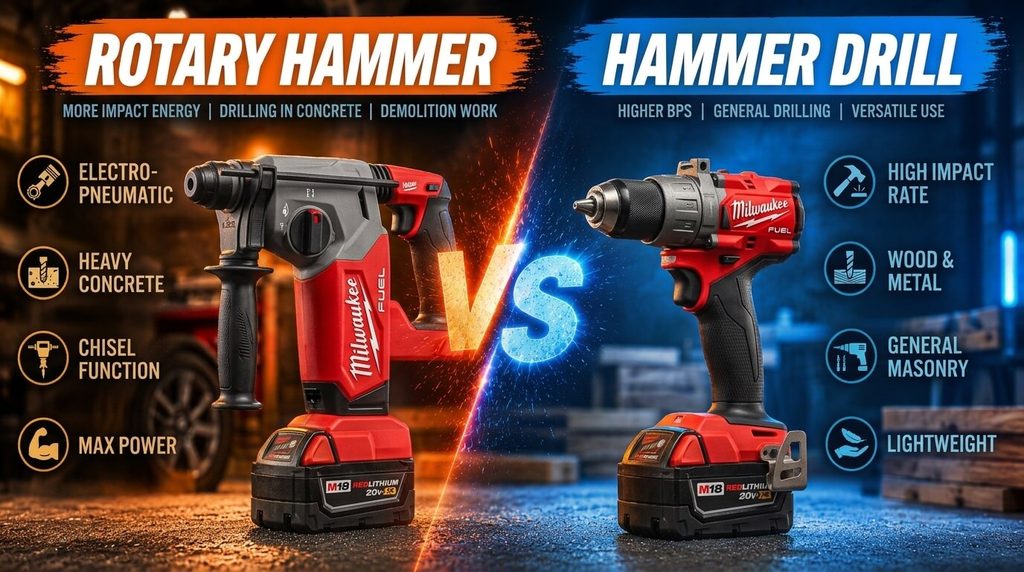
Hammer Drill vs Rotary Hammer: Quick Comparison
| Feature | Hammer Drill | Rotary Hammer |
| Main purpose | General drilling + occasional masonry | Concrete and masonry drilling |
| Hammering action | Mechanical percussion | Typically electro-pneumatic |
| Impact force | Lower | Much higher |
| Typical tool holder | Conventional chuck | Usually SDS-Plus or SDS-Max |
| Drill-only mode | Usually yes | Usually available on many models |
| Hammer-only mode | No | Available on many models |
| Chiseling | No | Yes, on models with hammer-only mode |
| Wood and metal drilling | Yes | Some models can, especially with compatible chuck/accessory |
| Concrete drilling | Small/occasional work | Repeated or demanding work |
| Size and weight | Usually smaller/lighter | Usually larger/heavier |
| Best for | DIY and light masonry | Concrete, anchors, chiseling and heavier masonry work |
The simplest way to remember it:
Hammer drill = a regular drill with a lighter hammering function.
Rotary hammer = a dedicated masonry/concrete tool with a much stronger hammer mechanism.
What Is a Hammer Drill?
A hammer drill also known as impact drill is a drill that can rotate a bit while also producing rapid forward-and-back percussion.
In simple terms, the bit doesn’t just spin—it also vibrates forward into the masonry as you drill.
Many conventional hammer drills create this percussion through interacting toothed discs or gears. When hammer mode is selected and the tool is pressed against the material, these components create the rapid hammering action.
This extra percussion helps the masonry bit break through materials such as:
- Brick
- Block
- Mortar
- Light masonry
- Some concrete applications
A hammer drill can normally switch between hammer drilling and regular drilling, so you can use it for ordinary drilling in materials such as wood and metal when the hammer function is turned off.
How Does a Hammer Drill Work?
The hammer drill adds a physical hammering motion to the spinning bit. Rather than just cutting, the bit is also being driven forward in rapid pulses pulverizing the masonry surface as it rotates.
This combination dramatically speeds up drilling through concrete, brick, and stone.
What Is a Hammer Drill Used For?
A hammer drill is useful when you occasionally need to make relatively small holes in masonry, such as:
- Installing shelves
- Hanging curtain rods
- Mounting brackets
- Installing wall anchors
- Drilling into brick
- Installing fixtures
- Making small holes in block or suitable concrete
Current hammer-drill specifications show that their masonry capacity varies considerably by model. For example, Makita’s GRH10Z 40V max XGT SDS-PLUS rotary hammer has a manufacturer-specified optimum concrete-drilling range of 3/16–1/2 inch (approximately 5–13 mm) and a maximum concrete-drilling capacity of 13/16 inch (approximately 21 mm). Bosch also lists models with different masonry capacities.
Therefore, don’t choose a hammer drill based on a universal hole-size rule, check the manufacturer’s rating for the exact tool.
What Is a Rotary Hammer?
A rotary hammer is a power tool designed primarily for drilling into concrete and masonry.
Instead of relying on the relatively light percussion of a conventional hammer drill, a rotary hammer typically uses an electropneumatic hammer mechanism to deliver much stronger impacts to the bit.
Think of the difference this way:
Hammer drill:
The bit rapidly vibrates against the material.
Rotary hammer:
An internal hammer mechanism repeatedly drives the bit into the material with much greater impact energy.
That stronger impact makes rotary hammers much more effective when working with hard concrete and demanding masonry applications.
For example, Bosch’s current GBH 2-26 rotary hammer delivers 3.0 J of impact energy and has three operating modes, including chiseling.
How Does a Rotary Hammer Work?
A rotary hammer uses an internal hammer mechanism that generates the impact independently of the simple mechanical vibration used by a conventional hammer drill. The motor rotates the bit while the hammer mechanism repeatedly drives it forward.
This means you don’t have to rely on simply pushing harder on the tool to create the hammering action. The result is a tool that can remove material much more aggressively than a conventional hammer drill.
Compared with conventional hammer drills, rotary hammers are generally larger and deliver greater impact force. They use an electro-pneumatic (EP) hammering mechanism, which generates the hammering action through an electrically powered internal piston system rather than relying on a separate external air compressor.
What Is a Rotary Hammer Used For?
Rotary hammers are commonly used for:
- Concrete drilling
- Masonry drilling
- Anchor holes
- Larger holes
- Repeated drilling
- Chiseling
- Removing tile
- Light demolition
- Chasing channels in masonry
Many rotary hammers have multiple operating modes. Depending on the model, you may get:
- Rotary only
- Hammer drilling
- Hammer only / chiseling
For example, current DEWALT SDS-Plus rotary hammers like DCH133M2, DCH273B, etc offer selectable drilling, hammer-drilling and chipping modes, while Bosch models like PRO GBH 2-26 similarly offer multiple operating modes.
Hammer Drill vs Rotary Hammer: What Is the Main Difference?
The biggest difference is the hammering mechanism and the amount of impact energy the tool can deliver.
A conventional hammer drill generally produces a lighter percussion effect through a mechanical mechanism.
A rotary hammer typically uses an electro-pneumatic mechanism that produces substantially stronger impacts.
This gives the rotary hammer a major advantage when drilling hard concrete or performing repeated masonry work.
A simple example
Imagine you need to drill a hole for a wall anchor.
With a hammer drill:
Bit rotates → light percussion → material breaks gradually → hole is created
With a rotary hammer:
Bit rotates → powerful piston-driven impacts → material breaks more aggressively → hole is created faster
The exact speed difference depends on the tool, bit, hole size, material and operator technique, so claims such as “a rotary hammer is always three times faster” should not be treated as a universal rule.
Hammer Drill vs Rotary Hammer: What About the Bits?
This is another major difference beginners notice.
Hammer drill bits
Hammer drills commonly use conventional round-shank bits held in a chuck.
The exact chuck capacity varies by model. Many hammer drills use conventional 10 mm or 13 mm-class chucks, although other sizes exist.
Bosch’s current chuck range includes 1.0–10 mm, 1.5–13 mm and 2.0–13 mm keyless chuck capacities. Bosch also lists 1.5–13 mm quick-change chucks for compatible rotary-hammer models.
For masonry, use a carbide-tipped masonry bit designed for hammer drilling.
Hammer-drill bits
- Masonry bit
- Carbide-tipped masonry bit
- Multi-material bit
- Tile/glass bit
Rotary hammer bits
Rotary hammers commonly use SDS-Plus or SDS-Max tool holders.
SDS bits have specially designed shanks that slide into the tool holder and allow the bit to move axially while remaining securely engaged with the hammer mechanism. This helps transfer the impact energy efficiently into the material.
For example, Makita’s SDS-Plus masonry bits are specifically designed for use with rotary hammers that accept SDS-Plus shanks.
Rotary-hammer bits
- SDS-Plus drill bit
- SDS-Max drill bit
- SDS-Plus chisel
- SDS-Max chisel
- SDS-Plus core bit
- SDS-Max core bit
How does the SDS system work?
A normal drill usually holds a bit with a three-jaw chuck. The chuck grips the smooth part of the bit tightly using friction.
But a rotary hammer works differently. It hits the bit thousands of times while it is rotating. With this much vibration, a normal friction-based chuck could gradually loosen its grip on the bit.
That is why rotary hammers use an SDS system. SDS bits have special slots (grooves) on their shank. These slots lock into the chuck using small locking balls so the bit stays securely attached even while the tool is hammering.
There is another important feature: the SDS bit is allowed to move slightly forward and backward inside the chuck. This movement is intentional. It allows the rotary hammer’s hammering mechanism to transfer its impact energy efficiently through the bit and into the concrete or masonry.
Why does the SDS system matter?
A normal chuck mainly grips the bit, while an SDS holder locks the bit in place and allows the small amount of movement needed for hammering.
SDS is not simply another type of drill bit. It is a tool-holder system designed for rotary hammer applications.
SDS-Plus vs SDS-Max: What Is the Difference?
You may see SDS-Plus and SDS-Max when shopping for rotary hammers. Both are SDS systems, but they are designed for different classes of tools and accessories.
SDS-Plus
SDS-Plus is very common on compact and mid-size rotary hammers.
It is commonly used for:
- Small and medium concrete holes
- Wall anchors
- Electrical installation
- Plumbing work
- General construction
- Light chiseling
For example, Bosch’s GBH 2-21 is an SDS-Plus rotary hammer with a 2 J impact rating and a manufacturer-specified concrete drilling range up to 22 mm.
SDS-Max
SDS-Max is generally found on larger, heavier-duty rotary and demolition hammers. These tools are designed for more demanding applications and larger accessories.
| Feature | SDS Plus | SDS Max |
| Tool size | Smaller, lighter rotary hammers | Larger, heavier rotary hammers |
| Shank | Smaller SDS Plus shank | Much larger SDS Max shank |
| Typical work | Anchoring, small concrete holes, light-to-moderate chiseling | Larger holes, heavier concrete drilling, demolition |
| Power | Lower power class overall | Higher power class overall |
| Bit sizes | Generally smaller solid bits | Generally larger solid bits |
| Chiseling | Suitable for lighter chiseling | Better suited to heavier chiseling/demolition |
| Handling | Easier to handle in confined areas and for extended lighter work | Heavier but designed for demanding work |
| Cost of accessories | Generally less expensive | Larger bits/accessories can cost more |
You should choose SDS-Plus or SDS-Max based on the type and size of work you actually need to perform—not simply because one sounds more powerful.
Are SDS Plus and SDS Max interchangeable?
No. SDS Plus and SDS Max are different tool-and-bit systems. An SDS Plus bit is not simply a smaller SDS Max bit that can be swapped between the two tools.
SDS Max uses a larger shank and rotary hammers use specialized bits rather than a conventional Jacobs-style chuck.
Which one is for drilling and which one is for chiseling?
Both can do drilling and chiseling if the particular rotary hammer has those functions.
The difference is primarily the scale of the work, rather than one being a drill and the other being a chisel-only tool. SDS Plus is suitable for smaller drilling/light-to-moderate chiseling and SDS Max for larger drilling/heavier demolition.
Both SDS Plus and SDS Max rotary hammers can drill and chisel. SDS Plus is generally suited to smaller holes and lighter-duty work, while SDS Max is designed for larger holes, heavier chiseling, and more demanding concrete and demolition applications.
Hammer Drill Vs. Rotary Hammer: For Concrete, Brick, Wood & Metal
Which Is Better for Concrete?
If your main question is “Which tool is better for concrete?”, a rotary hammer is generally the more capable option.
But that does not mean a hammer drill cannot drill concrete.
A hammer drill can handle suitable small holes in concrete especially when the concrete and bit are appropriate for the tool.
But when:
- The concrete is hard
- You need many holes
- The holes are larger
- You need deeper holes
- You’re drilling regularly
- You need to remove material with a chisel
A rotary hammer is substantially more effective. Current rotary hammers from manufacturers such as Bosch’s GBH 2-26 specify 3 J, 4–26 mm concrete drilling, and SDS-Plus. DEWALT similarly identifies impact energy and concrete drilling on its SDS-Plus rotary hammers.
Is a Hammer Drill Good for Brick?
Yes. A hammer drill is often a practical choice for brick and lighter masonry work.
For example, if you’re installing:
- Curtain brackets
- Shelves
- Pictures
- Small wall anchors
- Electrical brackets
A hammer drill may provide enough performance.
However, the correct bit is important. Use a masonry bit designed for the material and the drilling mode recommended by the tool manufacturer.
Is a Rotary Hammer Good for Brick?
Yes, but it can be more of a tool than you need for small jobs.
A rotary hammer is capable of drilling brick and masonry but its stronger hammer mechanism can make it less suitable when you need a very gentle approach.
For small holes in softer brick, a conventional hammer drill may provide more than enough performance.
For larger holes, repeated drilling, tough masonry or chiseling, a rotary hammer becomes much more useful.
The choice should therefore depend on the material, hole size and amount of work rather than simply choosing the strongest tool.
Can a Rotary Hammer Drill Wood and Metal?
Some can, but it depends on the model and accessory.
A rotary hammer is primarily designed around masonry and concrete work.
However, some models can operate in rotary-only mode and may accept an interchangeable chuck or suitable accessory for conventional drill bits.
For example, Bosch’s GBH 2-26 F supports three modes and includes a quick-change chuck compatible with cylindrical bits.
So don’t assume every rotary hammer can conveniently replace your regular drill.
For everyday:
- Wood drilling
- Screwdriving
- Furniture assembly
- General household work
A regular drill/driver remains the more natural tool.
What If I Only Need to Drill a Few Holes?
This is where many beginners overthink the decision.
If you only need to drill a few small holes in brick, block or suitable concrete, a hammer drill may be completely adequate if the tool and bit are properly rated for the job.
If you’re dealing with hard poured concrete and your existing drill struggles badly, a compact rotary hammer can save considerable time and effort.
Hammer Drill or Rotary Hammer: Which One Is Easier to Use?
It depends on the job.
For general drilling, a hammer drill is often easier to integrate into your toolbox because it can perform normal drilling as well as masonry drilling.
A rotary hammer is usually more specialized, but it can make demanding concrete work significantly easier because its hammer mechanism does much more of the material-breaking work.
Rotary hammers are also commonly heavier than compact hammer drills, although actual weight varies significantly between models.
For example, Bosch’s PRO GBH 2-26 rotary hammer weighs 3 kg and the PRO GSB 600 impact drill weighs around 1.7 kg. Bosch’s PRO GBH 2-21 rotary hammer weighs and the PRO GSB 21-2 RE impact drill weighs around 2.85 kg.
Can a Hammer Drill Replace a Rotary Hammer?
For occasional small masonry holes, sometimes yes.
For regular concrete drilling, usually not.
A hammer drill gives you versatility because it can function as a conventional drill and add percussion when needed.
A rotary hammer sacrifices some of that general-purpose simplicity in exchange for much stronger masonry and concrete performance.
That’s why the two tools are not simply “weak vs strong versions of the same thing.” They are designed around different priorities.
Can a Rotary Hammer Chisel?
Many rotary hammers can.
If the tool has a hammer-only mode, you can use an appropriate chisel accessory for tasks such as:
- Removing tile
- Chipping mortar
- Breaking small sections of masonry
- Chasing channels
- Light demolition
Bosch’s GBH 2-26 has a chiselling function, while DEWALT models such as the DCH133 and DCH273 provide a chip/chipping mode.
A conventional hammer drill does not normally provide this hammer-only function. This is one of the biggest practical advantages of a rotary hammer.
Hammer Drill or Rotary Hammer: Which One Should You Buy?
Instead of asking “Which tool is better?”, ask:
“What am I actually going to drill?”
Choose a hammer drill if:
- You already need a general-purpose drill.
- You occasionally drill into brick or masonry.
- Most holes are relatively small.
- You want one versatile tool.
- You also drill wood and metal.
- You don’t need chiseling.
- Your masonry work is relatively light.
Choose a rotary hammer if:
- You regularly drill concrete.
- Your concrete is hard or dense.
- You need many anchor holes.
- You need larger or deeper masonry holes.
- You need to drill concrete efficiently.
- You want a hammer-only chiseling function.
- You expect heavier masonry work in the future.
Hammer Drill vs Rotary Hammer: Pros and Cons
Hammer Drill
Pros
- More versatile
- Can perform regular drilling
- Useful for wood and metal
- Good for occasional masonry work
- Usually more compact
- Often easier to use for general DIY
- Uses widely available conventional drill bits
Cons
- Less effective in hard concrete
- Slower for demanding masonry work
- Not designed for heavy chiseling
- Less suitable for repeated concrete drilling
Rotary Hammer
Pros
- Much stronger hammering action
- Excellent for concrete and masonry
- Efficient for repeated holes
- Commonly uses SDS accessories
- Many models offer hammer-only chiseling
- Better suited to larger masonry applications
Cons
- More specialized
- Usually heavier
- SDS accessories are required for SDS tool holders
- Can be unnecessary for very light masonry work
- Not the natural choice for everyday screwdriving and general drilling
Conclusion
The difference is easiest to understand by looking at the job rather than the tool name.
A hammer drill is a versatile drill that adds percussion for masonry. It’s a practical choice for occasional small holes in brick, block and suitable concrete.
A rotary hammer is a more specialized masonry and concrete tool. Its stronger hammer mechanism, SDS accessories and optional chiseling modes make it better suited to hard concrete, repeated drilling, larger holes and demanding masonry work.
So, if your typical job is “I need to put a few anchors into a brick wall,” a hammer drill may be enough.
If your typical job is “I need to drill concrete regularly and don’t want to fight the material,” a rotary hammer is the tool class to look at.
The most important factors are material, hole diameter, hole depth, number of holes, required tool mode, accessory system and manufacturer-rated capacity—not simply the tool’s voltage or advertised power.
FAQ
Is a rotary hammer stronger than a hammer drill?
Generally, yes. Rotary hammers are designed to deliver substantially greater impact energy than conventional hammer drills, making them better suited to demanding concrete and masonry work.
Can a hammer drill drill concrete?
Yes. A properly rated hammer drill with the correct masonry bit can drill suitable concrete holes. However, a rotary hammer is generally more efficient for harder concrete, larger holes and repeated drilling.
Can a rotary hammer drill concrete?
Yes. Concrete drilling is one of the main purposes of a rotary hammer.
Is SDS the same as a rotary hammer?
No. SDS is a tool-holder system, while a rotary hammer is the power tool that commonly uses that system.
Is SDS-Plus better than a normal chuck?
They are designed for different purposes. SDS-Plus is designed to efficiently transfer hammering energy in rotary hammer applications, while a conventional chuck provides greater compatibility with standard straight-shank drill bits.
Can a rotary hammer be used as a regular drill?
Some models can operate in rotary-only mode, and some accept conventional bits through a compatible chuck or adapter. Check the manufacturer’s specifications for the specific model.
Can a rotary hammer replace a hammer drill?
It can replace it for many masonry and concrete tasks, but it does not necessarily replace the versatility of a conventional drill/driver. For everyday wood, metal and screwdriving work, a regular drill is often more convenient.
Can a hammer drill replace a rotary hammer?
For light masonry work, it may be sufficient. For frequent or demanding concrete drilling, a rotary hammer is generally better suited to the job.
Do rotary hammers come in cordless versions?
Yes. Cordless rotary hammers are widely available, including 18V, 20V and higher-voltage systems. Current Bosch, DEWALT and Makita ranges include cordless SDS rotary hammers.
Can you drill holes with a rotary hammer?
Yes. Rotary hammers are designed to drill holes in concrete, brick, and masonry. Many models also offer rotary-only and hammer-only modes.
Will a rotary hammer drill break concrete?
Yes. A rotary hammer can break or chip concrete when used with a suitable chisel and hammer-only mode, depending on the tool’s impact energy.
Can you use a rotary hammer drill as a jackhammer?
For small chiseling and demolition jobs, yes. However, a rotary hammer is not a direct replacement for a dedicated jackhammer on large or heavy demolition projects.
Is there a difference between a rotary hammer and a hammer drill?
Yes. A rotary hammer generally delivers stronger impacts and is designed for demanding masonry and concrete work. A hammer drill is better suited to lighter drilling in brick and masonry.
What are the downsides of rotary drilling?
Rotary hammers can be heavier, more expensive, noisier, and less convenient for general-purpose drilling than standard drills, especially for light-duty jobs.
Can I drill into a cinder block without a hammer drill?
Yes. You can drill cinder blocks with a regular drill and suitable masonry bit, but a hammer drill can make the job faster and easier.
Should I buy a hammer drill or a regular drill?
Choose a regular drill for wood, metal, plastic, and everyday screwdriving. Choose a hammer drill if you also need to drill occasional holes in brick, block, or light masonry.
What is the best hammer drill for home use?
The right choice depends on your projects. For occasional masonry work, look for a comfortable drill with variable speed, a hammer mode, adjustable clutch, and suitable chuck capacity.
Can I use regular drill bits in a hammer drill?
Yes, for rotary drilling. However, use masonry-rated bits for masonry and concrete. When hammer mode is engaged, use bits specifically designed for hammer drilling.
Need to Remove Tile or Chip Masonry?
Use a rotary hammer with hammer-only mode. It delivers stronger impact force and lets you use chisels for removing tile, mortar, and masonry without rotating the bit.
Drilling Concrete for Anchors Regularly?
Use a rotary hammer. It drills concrete efficiently and handles repeated anchor holes with less effort than a standard hammer drill.
Installing Small Wall Anchors Occasionally?
A hammer drill may be enough. It can handle occasional small holes in brick, block, or light masonry. For frequent concrete drilling or larger holes, choose a rotary hammer.
