
What’s actually causing movement of the tools in your hand? The answer is a brushed or brushless motor. A motor is the core component that powers a tool’s movement or working force to drive the bits or blades or grinder wheels etc.
Nobody spends their day thinking about motor technology — you’re probably thinking about finishing a project on the weekend or fixing something around the house. Have you ever stared at two identical power tools and wondered why there are two different price tags? That’s because of the motor system.
Whether you’re a beginner on a budget or DIYer handling weekend repairs or a professional relying on tools every day, knowing how these motor systems work can make a big difference in performance and durability.
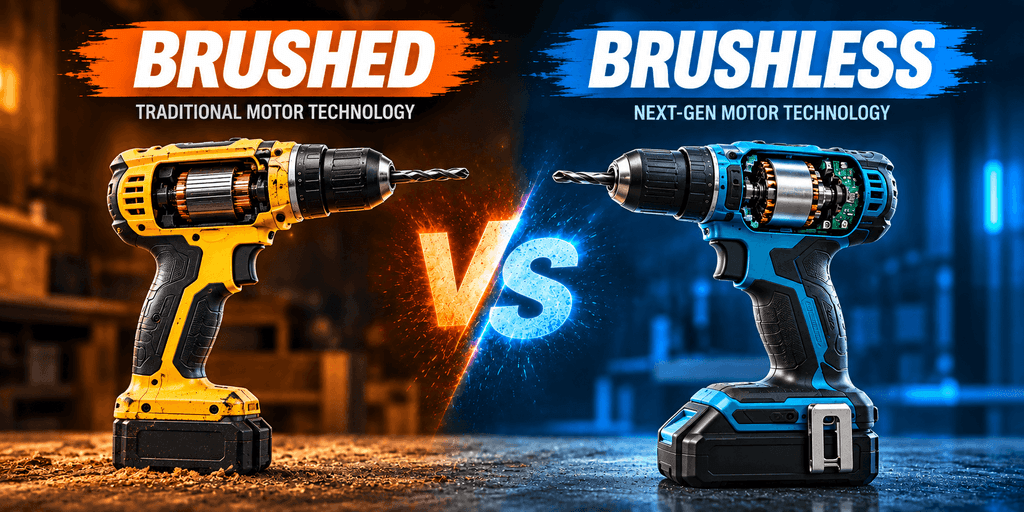
What is a Brushed Motor?
The brushed motor has carbon brushes. These brushes make contact with the commutator to power the motor. These motors are simple in structure and cost effective. But the constant friction between carbon brushes and commutators create more heat, more noise and eventual wear out of brushes.
What is a Brushless Motor?
As the name suggests, this motor doesn’t have brushes. Rather an electronic controller manages the flow of current within the motor. Without brush-to-commutator contact, there is far less friction inside the motor. This design reduces heat and wear. These motors are also typically quieter and more compact than brushed motors.
How Each Motor Type Actually Works
How Does a Brushed Motor Work
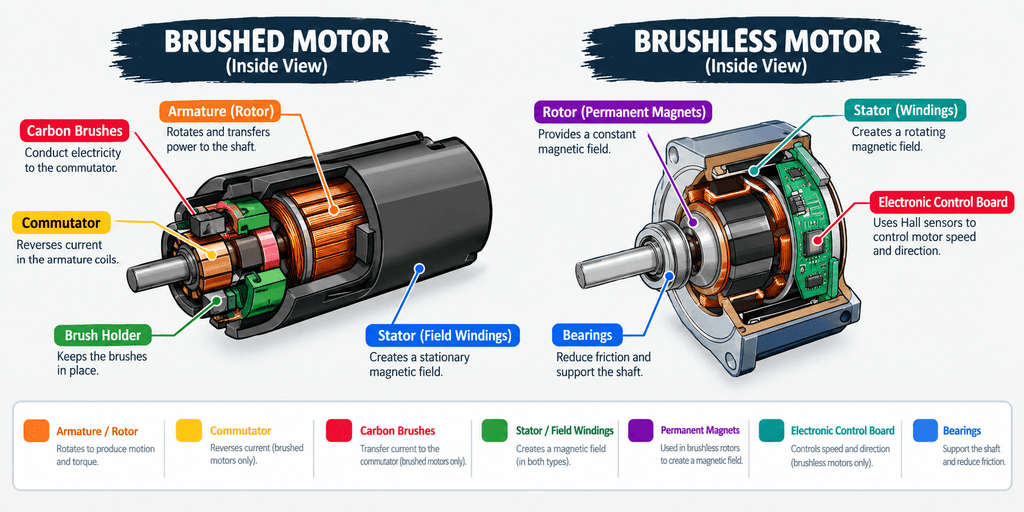
A brushed motor operates by transferring electrical current via carbon brushes that contact a revolving commutator. The commutator is attached to the armature. The armature is the motor’s rotating section that contains wire coils.
Electricity flows through these coils and creates a magnetic field. This magnetic field interacts with the permanent magnets within the motor casing. This process generates a force that causes the armature to rotate.
The commutator is the key component in this process. As the armature spins, the commutator constantly changes the direction of current flowing through the coils. This regular switching keeps the magnetic forces moving in the right direction and causes the motor to continuously rotate.
Brushed power tools work by using a more traditional and mechanically simple brushed technology. Most corded tools use brushed motors. Some corded tools also use brushless but these are more often found in heavy-duty professional models.
How Does a Brushless Motor Work
A brushless motor works using an electronic controller and sensors — commonly Hall sensors. This system manages current flow through the stator windings instead of physical brushes and a mechanical commutator like brushed one.
This motor still relies on magnetic attraction and repulsion to create motion but the design is more advanced and efficient than a traditional brushed motor.
In a brushless motor, the rotor contains permanent magnets — the spinning part of the motor and the stator remains stationary around it with electromagnetic coils. The electronic controller rapidly switches electrical current between the stator windings in a precise sequence that creates a rotating magnetic field.
As this magnetic field rotates, it continuously pulls and pushes the permanent magnets on the rotor. This causes the motor to spin smoothly. Brushless technology provides two major advantages – Higher efficiency and Longer lifespan.
Brushless power tools generally use a brushless DC (BLDC) motor. But some brands like Hikoki are incorporating AC brushless motors. Brushless designs are especially popular in cordless tools because they cooperate with batteries in a better way.
Performance Overview of Brushed vs Brushless Motors
Motor lifespan: 1,000-3,000 vs 10,000+
One technical comparison says brushed motors are typically around 1,000-3,000 hours, while BLDC motors commonly exceed 10,000 hours and even some exceed 30,000 hours depending on bearings and controller quality.
The underlying reason is that brushed motors wear brushes and commutators, while brushless motors remove that contact wear point.
Power Efficiency
According to the “Analyzing The Bldc Motor for Automatic Gate” research paper, all BLDC topologies achieve >88% efficiency compared to <65% for conventional brushed systems. Experimental analysis conducted on multiple BLDC motor configurations reveals optimal design parameters achieving 89.2% peak efficiency.
The brushless DC motors are 85% to 90% more efficient than the brushed motors whose efficiency rate is around 80%.
Operating Speed
Brushed motors work best at speeds between 1,000 and 10,000 RPM. At higher speeds, the brushes can lose contact with the commutator, reducing performance. In contrast, brushless motors can operate at much higher speeds.
Battery runtime
According to an article “Improving the efficiency of Brushless DC (BLDC) electric motors using a Proportional-Integral-Derivative (PID) based control system” , integrated BLDC motors show interpret runtime and lower power consumption.
Speed Range
While brushed motors can speed Up to ~10,000 rpm; limited by brush arcing. Brushless motors can speed up to 6,000-50,000 rpm depending on design.
Brushed vs Brushless Motor: Pros & Cons
| Feature | Brushed Tools | Brushless Tools |
| Upfront cost | Lower initial price, which makes them attractive for budget buyers and occasional users. | Higher initial price, but often better value over time for frequent users. |
| Maintenance | Easier to service, but brushes wear out and may need replacement. | Lower routine maintenance because there are no brushes to replace. |
| Lifespan | Usually shorter because brush wear and commutator wear limit long-term use. | Usually longer because the design removes one major wear point. |
| Efficiency | Less efficient, so more energy is lost as heat. | More efficient, which helps battery runtime and overall performance. |
| Heat and noise | Tends to run hotter and louder because of brush friction. | Tends to run cooler and quieter due to reduced friction. |
| Power delivery | Works well for basic tasks, but performance may drop more under heavy load. | Delivers more stable power and better control under load. |
| Best for | Light, occasional, or budget-focused use. | Frequent, demanding, or professional use. |
Brushed vs. Brushless Power Tool Motor: Things to Consider Before Buying
Factors about brushed & brushless motors you must consider in order to choose the best one for your needs.
1. Friction, Wear, & Tear
Brushed motors use carbon brushes to maintain electrical contact with a rotating commutator. This physical contact produces mechanical friction at the brush-commutator interface.
That friction causes spark, generates heat, and gradually causes wear of both the brushes and commutator surfaces. Over time, this wear can degrade commutation quality, reduce efficiency. That’s why brushed motors require brush replacement or commutator servicing.
Brushless motors eliminate the brush-commutator interface entirely. Instead of mechanical commutation, they rely on electronic switching to energize the stator windings in sequence.
This design reduces friction, lowers heat generation, improves efficiency, and reduces maintenance requirements. Brushless motors generally offer longer service life, better heat stability, and improved performance under sustained load.
Brushless does not mean zero wear. Bearings, electronics, gears, and cooling paths can still fail. But compared with brushed motors, they generally produce less internal friction, less heat, and less day-to-day maintenance.
2. Power Density & Efficiency
At the same voltage, brushless tools are generally more powerful and efficient than brushed tools. Electronic control allows the motor controller to regulate current more precisely and reduce wasted energy. This improves performance and runtime also reduces energy loss which helps brushless tools maintain speed and torque better under load.
Sometimes, a brushless motor can demand more power with the motor overloaded. This generates excessive heat which can hamper the magnets of the rotor.
Industry references commonly place brushless motor efficiency around 85–90%, compared with 75–80% for brushed motors in many tool applications. That difference matters most under sustained load, where brushed tools lose more energy as heat and friction.
3. Runtime and Battery Utilization
Brushless cordless tools use the available battery energy more effectively than brushed ones. They often deliver longer runtime on the same battery capacity.
Their electronic controllers’ precise regulation of power reduces wasted energy during lighter tasks and improves performance under load. That is especially useful on 18V and 20V platforms — where every bit of efficiency translates into more holes drilled, more fasteners driven, or more cuts completed per charge.
As a result, brushless tools can complete more work per charge. That reduces battery swaps and improves productivity on larger projects. That is why a brushless tool often finishes more work before the pack needs to be swapped or recharged than brushed ones.
4. Initial vs. Long-Term Costs
Upfront Cost
One of the main advantages of brushed motors is their lower initial cost. Their design is simpler and their manufacturing process is well established.
On the other hand, brushless motors require more advanced electronics which raises the purchase price or upfront cost.
Long-term cost
Brushed motors have wear parts especially their carbon brushes. So they may need servicing or replacement during the tool’s life. That creates extra cost in parts, labor, and downtime.
Brushless tools usually reduce those expenses because they have no brushes to replace and often run more efficiently. They offer better long-term value.
For occasional users, brushed tools may be the most economical choice upfront. But for frequent or professional use, brushless tools often become the more cost-effective option over the life of the tool.
Are Brushless Tools Worth The Extra Money?
Yes — for most regular users and professionals, brushless tools are usually worth the extra money.
You pay more upfront. But you often get better runtime, less maintenance, lower heat, and longer service life. So the total cost over time can be lower because there is no maintenance fee for brushes replacement.
Brushed models may still be the more economical choice for users who only need tools once in a few months because the extra performance of brushless may not justify the higher purchase price.
- Occasional DIY use (light to mid jobs): brushed is usually fine.
- Regular use (mid to heavy tasks): brushless is often the better value.
- Professional or heavy use: brushless is usually the clear choice.
5. Smaller & Lighter
Brushless tools do not have physical brushes and a commutator assembly inside the motor. That’s why they are often more compact and lighter than brushed tools. This design technology helps manufacturers design shorter tool bodies for tighter work areas which are easy to carry around for a long day.
Brushless is not always dramatically lighter in every model as the final weight difference also depends on the battery, gearbox, housing, and electronics.
6. Noise & Comfort
Brushed motors are often noisier than brushless motors. Brushless tools reduce internal friction and eliminate brush noise. They often feel smoother and less fatiguing during long use.
Meanwhile, in brushed tools as the brushes wear down over time, the noise gets louder. Also, when the motor starts up, it might be sparking, which adds additional noise to the process.
Lower noise matters not only for comfort but also for perceived quality. especially in precision tasks where a tool that sounds smoother often feels better controlled.
In some applications, brushless tools can still become loud at high speed because of airflow, gearbox noise, or cutting load, but the sound is usually less harsh than a brushed equivalent. They are usually quieter in various applications like disk drives or medical machines.
7. Vibration and control
Brushless motors can deliver torque more smoothly than brushed ones because electronic control allows better regulation of motor output. That usually means less pulsation, fewer sudden surges, and better control during fastening, drilling, or fixture work.
Reduced vibration does not come only from the motor itself, though; the whole tool design, balance, and bit or blade interaction also matter.
8. Less Maintenance
Brushed tools have carbon brushes that wear down because they constantly rub against the commutator. That makes brushes a consumable part. So they eventually need inspection and replacement, and worn brushes can also damage the commutator if ignored.
Brushless tools remove that brush-and-commutator wear point, so they generally need less routine servicing and fewer wear-part replacements.
Brushed tools usually require occasional brush replacement based on use intensity, while brushless tools reduce that maintenance burden because they have no brushes to replace.
9. More Responsiveness
Brushless tools are more responsive because electronic control can adjust power delivery more precisely under changing load. That means better torque control, faster recovery when the bit binds or load changes, and more consistent performance during demanding tasks. This is one reason brushless tools feel more in control than brushed tools in use. Brushed motors typically have lower torque density and less efficient torque delivery than brushless motors.
10. Performance Under Temperature and Working Environment
Brushless and Brushed motor performance can vary depending on the working environment and temperature.
- Under Heat:
Brushless motors handle heat better than brushed motors in demanding use. Because they have no brush friction, they generate less internal heat and are less likely to overheat during long work sessions or in hot weather.
Brushed motors create more heat from mechanical contact, so they are more likely to lose efficiency or trigger thermal protection when pushed hard for extended periods.
- Under Cold Weather:
Both motor types can still operate in cold conditions, but brushless tools usually have a slight edge. Their electronic control system can help maintain steadier power delivery as battery performance drops in lower temperatures.
Brushed motors may feel a bit weaker in the cold because battery output and motor efficiency can both decline.
- In Dusty and Dirty Environments:
Brushless motors are generally better suited to dusty or dirty work areas. Since they do not use brushes, there is less wear from debris and no brush sparking to worry about.
Brushed motors are more vulnerable to contamination, which can increase wear, reduce performance, and create more frequent maintenance needs.
Brushless motors are more Compatible with cordless tools than corded ones
Brushless motors are generally more compatible with cordless tools than corded tools because cordless tools have a limited battery supply, and brushless motors use that battery more efficiently.
In simple terms, brushless motors waste less energy as heat and friction, so more of the battery goes into actual work, which gives longer runtime, steadier power, and less overheating.
Why cordless tools have benefit with brushless motors
Cordless tools depend entirely on battery power, so efficiency matters a lot. Brushless motors do not use carbon brushes or a rubbing commutator, which reduces friction and energy loss.
And which can extend runtime by up to about 50% on some tools. They also let the controller adjust power quickly as the load changes, which helps the tool stay strong when drilling, cutting, or driving screws.
Why corded tools need brushless motors less
Corded tools have a continuous power source from the outlet, so they are not as limited by battery life. That means the main advantage of brushless motors in corded tools is usually performance, cooler running, and less maintenance, not battery savings.
In other words, brushless still helps in corded tools. But the big “wow” factor shows up more clearly in cordless tools because every bit of efficiency directly improves runtime.
Should You Buy Brushless or Brushed Power Tools?
The answer depends mainly on how often you use them and how demanding your projects are. Brushless tools are the better choice for professionals, heavy DIY users, and anyone who works with tools daily or weekly.
Choose brushless tools if you use them often, work on demanding projects, or want better battery runtime and lower maintenance. Choose brushed tools if your jobs are light, occasional, and budget-driven. Because they are usually affordable and still dependable for basic work.
When to Choose Brushless Tools
Brushless tools are the better fit for daily or weekly use. Especially if you do mid-to-heavy tasks such as drilling into dense material, driving long screws, cutting repeatedly, grinding, or working on renovation and jobsite work.
They are also the smarter choice because brushless motors run cooler, and maintain more stable torque under load. For professionals, that usually means less downtime, fewer battery swaps, and less wear over time.
Brushless tools are especially good for:
- Impact drivers.
- Drill drivers.
- Circular saws.
- Reciprocating saws.
- Angle grinders.
- Rotary hammers and impact wrenches.
When to Choose Brushed Tools
Brushed tools make more sense for monthly or once-in-a-few-months use. Especially for light tasks like assembling furniture, drilling a few anchors, hanging shelves, or making small repairs. They are usually more affordable, simple to understand, and reliable enough for casual home use.
Brushed tools are often fine for:
- Basic drills.
- Small screwdrivers.
- Occasional saw use.
- Light sanding or trim work.
- Simple household repairs.
Workload Guide
| Workload | Typical use | Better choice | Why |
| Light | Furniture assembly, small repairs, drilling a few holes | Brushed | Lower upfront cost, enough performance for occasional use |
| Mid | Regular DIY, renovations, frequent drilling and driving | Brushless | Better runtime, cooler operation, more stable power under load |
| Heavy | Daily jobsite use, cutting, drilling dense materials, repetitive fastening | Brushless | More efficient, more durable, less maintenance, better for long sessions |
Usage Frequency Guide
- Daily: Brushless is usually the right choice because repeated use makes efficiency and durability matter more.
- Weekly: Brushless is often worth it, especially for mid-to-heavy tasks and cordless tools.
- Monthly: Either can work, but brushless is better if the projects are demanding; brushed is fine if tasks are simple.
- Once every few months: Brushed is usually the better value because upfront price matters more than long-term efficiency.
Building a Mixed Tool Collection: A Strategic Approach
A mixed collection is often the smartest approach because it puts your money into brushless tools where performance matters most, while saving with brushed tools for occasional or low-demand jobs.
- Core tools: Choose brushless for the tools you use most often, like a drill/driver, impact driver, and circular saw. Because they handle frequent, heavy use better and give stronger overall performance.
- Specialized tools: Choose brushed for tools you use only sometimes, such as an oscillating multi-tool, jigsaw, or specialty fastener. Because they save money and are usually enough for short jobs.
- Light-duty accessories: Choose brushed for low-power items like inflators and work lights. since they do not need high torque or long runtime, and the cheaper motor is usually the better value.
- High-demand tools: Choose brushless for power-hungry tools like angle grinders and reciprocating saws. Because they run hotter and harder, so brushless gives better efficiency, cooler operation, and longer runtime.
Smart Features in Brushless Tools
- Automatic Mode Selection: Adjusts power based on load for better performance in different materials.
- Overload Protection: Prevents motor damage when the tool is under too much strain.
- Battery Management: Extends battery life and helps avoid over-discharge.
- Bluetooth Connectivity: Lets some tools connect to apps for diagnostics and settings.
- LED Indicators: Shows battery level, tool status, and sometimes operating mode.
- Electronic Brake: Stops the motor faster and more precisely for better control and safety.
Future Trends: Where Power Tool Motor Technology is Heading
- Brushless motors will keep becoming the standard in most cordless tools because they are efficient, durable, and easier to control electronically.
- Motor designs will continue to focus on reducing heat, friction, and energy loss. In practical terms, that means longer runtime, cooler operation, and longer tool life.
- Manufacturers are pushing for more compact motor assemblies. This matters because users want tools that are powerful but still easy to handle for long periods.
The future of power tools is heading toward high performance technologies that will ensure more brushless, more efficient, more intelligent, and more user-friendly designs.
Maintenance and Serviceability
Maintaining Brushed Tools
Brushed power tools require more routine maintenance because the carbon brushes gradually wear down through constant contact with the commutator. As the brushes wear, motor performance can decline, and the tool may begin producing more sparks, heat, or noise.
Common maintenance tasks for brushed tools include:
- Cleaning dust and debris from air vents
- Inspecting the brushes for wear
- Replacing worn carbon brushes
- Checking for excessive sparking or power loss
- Inspecting the commutator for burn marks or damage
- Keeping bearings, chucks, and moving parts clean and lightly lubricated
If brushes become too short or damaged, the motor may lose efficiency or stop working entirely. Under heavy professional use, brush replacement may be required periodically to maintain performance and prevent further motor damage.
Maintaining Brushless Tools
Brushless tools require far less maintenance because they do not use brushes or a mechanical commutator. Since there are fewer friction-based wear components inside the motor, there is less internal wear over time.
Most brushless tool maintenance focuses on general care and inspection, including:
- Keeping vents and cooling areas clean
- Removing dust and debris from the housing
- Cleaning battery terminals and contacts
- Checking for loose screws or damaged switches
- Monitoring for unusual vibration or noise
- Inspecting batteries and electronic components
Because brushless motors rely heavily on electronic controllers and sensors, electrical or control-related faults can be more complex to repair. However, under normal use, brushless tools typically require much less routine servicing than brushed models.
FAQ
Can corded power tools be brushless?
Yes. Corded power tools can use brushless motors. They use electronic controls instead of carbon brushes. However, brushed motors remain common in corded tools because they are simple, affordable, and easy to maintain.
What are the downsides of a brushless motor?
Brushless motors usually cost more and require electronic control circuits. Their design also makes repairs more complex. If the electronic controller fails, repair costs can be higher than replacing brushes in a brushed motor.
Are brushless tools really worth it?
Yes, a brushless tool can offer better efficiency, longer runtime, less maintenance, and longer motor life. These benefits matter most when you use the tool frequently or for demanding jobs.
What are the downsides of using a brushless drill?
A brushless drill usually costs more than a comparable brushed drill. It also depends on electronic controls, which can make repairs more expensive.
Do brushless power tools last longer?
Generally, yes. Brushless motors have no carbon brushes or commutators that wear through friction. This reduces mechanical wear inside the motor. However, overall tool life also depends on the battery, electronics, bearings, workload, maintenance, and operating conditions.
Should I get a brushed or brushless drill?
Choose a brushless drill if you want better efficiency, lower maintenance, and longer motor life. Choose a brushed drill if you want a lower purchase price.
What is the lifespan of a brushless motor?
A brushless motor can last for many years because it avoids brush and commutator wear. However, manufacturers do not use one universal lifespan figure. Actual life depends on workload, heat, bearings, electronics, maintenance, and operating conditions.
