
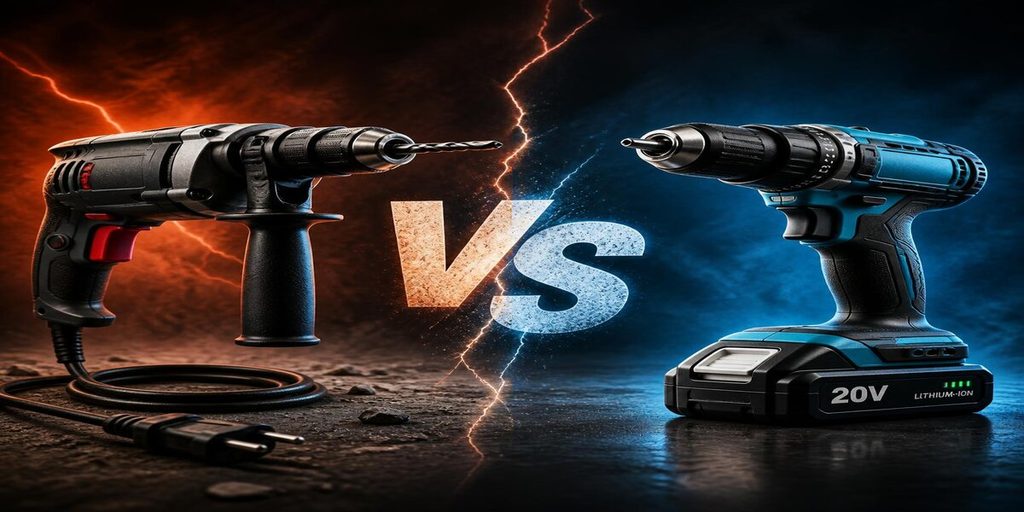
Cordless vs. Corded tools is a comparison of two categories of power tools in terms of power source, performance, and practical usability. The controversy is not just about having a battery or not.
Tool enthusiasts often have a thought, “Ok, but which one is convenient for me?” The answer depends on the task you’re performing, the duration of use, and the workplace. Let’s dive into the answer.
What Are Corded Power Tools?
Corded power tools are operated by being plugged directly into an electrical outlet. They provide a continuous and reliable source of energy for consistent performance. They are commonly used for heavy-duty and long-duration tasks because they offer uninterrupted power. However, they have limited mobility due to the attached cord. The common corded tools are drills, saws (miter saws, circular saws, chainsaws), Pressure washers, electric lawn mowers, trimmers, sanders, and grinders.
What Are Cordless Power Tools?
Cordless power tools run on rechargeable batteries, such as lithium-ion or nickel-cadmium. These tools allow users to work without being plugged into a power outlet. They offer portability and flexibility for various tasks. However, their runtime depends on battery capacity. The common corded tools are cordless drills and cordless hammer drills, impact drivers, battery powered chainsaws, cordless lawn mowers, etc. The voltage of batteries ranges from 10.8 to even 120V.
Corded vs Cordless Tools: Key Differences
Power Supply vs Battery Runtime
The mechanical break down on how the corded tools can supply continuous power is given below:
- Power Input – The tool receives AC voltage from the source through the cord. The cord’s copper wires carry current into the tool’s internal circuit.
- Energy Conversion – The current flows into the electric motor where electromagnetic forces are generated. In brushed motors, current passes through brushes and a commutator which creates a rotating magnetic field. In brushless motors, electronic circuits control magnetic fields more efficiently. This step converts electrical energy into mechanical rotation.
- Mechanical Transmission – The rotating motor shaft then transfers motion through gears, belts, or direct drive systems to increase torque or adjust speed depending on the tool.
- Output Work – The mechanical motion powers the working part:
Drill → rotating chuck
Saw → spinning blade
Grinder → rotating disc
This motion performs the actual task like cutting, drilling, or grinding.
- Continuous Power Supply – As long as the tool is connected and the trigger is engaged to the source, power flows constantly.
Cordless tools require battery recharge to operate. Several things affect how long cordless tool batteries run. Battery runtime of cordless power tools are measured by factors such as Ah (ampere-hours), battery age, work-load, Environment (temperature & humidity).
- Ah – Ah represents the battery’s capacity. A higher Ah rating indicates that the battery can either supply more current for the same amount of time or deliver the same current for a longer period of time.
Summary of Battery Tiers of some Major Brands
| Tier | Typical Capacity (Ah) | Primary Use Case |
| Compact | 1.5Ah – 2.0Ah | Light tasks; overhead work; everyday carry tools |
| Standard | 3.0Ah – 5.0Ah | General construction; framing; cabinetry; drilling |
| High Output | 6.0Ah – 12.0Ah+ | Demolition; cutting; large-scale landscaping; heavy fabrication |
- Battery Age – Batteries decay over time due to chemical wear (particularly lithium-ion cells). This decreases their ability to store a charge; older batteries have shorter runtimes even when fully charged.
- Workload – Heavy tasks (cutting hardwood, grinding metal) exhaust the battery faster.
- Environment – Extreme heat or low temperature and humidity leads to battery degradation and disruption of chemical efficiency.
Torque and RPM
To understand how torque and RPM perform in corded and cordless equipment, you must separate two basic concepts:
Torque = twisting force (power to push through material).
RPM (revolutions per minute) = speed of rotation.
These two have opposite connections. More torque refers to less speed and higher speed means less torque.
Corded tools have constant power. The motor can maintain torque continuously without dropping. As the torque remains high and constant, the RPM or speed of rotation remains stable. Corded tools are better for long-duration, heavy-duty work.
The torque in cordless tools depends on battery voltage and motor type (brushed or brushless). Cordless tools are more likely to have variable speed control designed like drill’s clutch system. So the RPM or speed of rotation can be changed hence the torque decreases or increases according to the RPM. Cordless tools are better for mobility, short-to-medium tasks.
Brands nowadays offer a variable range of RPM and torque by product line and model for various task purposes. Some comparisons are given below:
If you’re drilling a pilot hole in soft wood, higher RPM and moderate torque work well. If you’re driving a long lag screw into hardwood, you need higher torque and lower RPM for control and power.
Weight and Ergonomics
The weight and ergonomic design of a power tool greatly affect comfort, control, and fatigue during use. Especially when you are performing extended or overhead tasks. Cordless tools are generally heavier because of their battery packs. That can increase strain on the shoulders and arms over long periods. Corded tools are usually lighter and easier to handle for precision work. However, cordless tools offer greater mobility because they eliminate the hassle of managing cords. Whereas corded tools restrict movement and cause tripping problems. That’s also exhausting.
Ergonomics also includes balance, grip shape, vibration, and how the tool behaves during use.
Cordless tools provide mobility and no hassle with cords when you need easier handling in tight spaces. Corded tools provide precision when you want lower hand weight and long use at a fixed workspace.
Power Comparison: Cordless vs Corded
As we discussed in Torque and RPM on how power and speed work for corded and cordless tools. Again power and speed preference depends on what tasks you are performing.
Corded grinders, sanders, and miter saws remain more preferable for continuous job handling. While cordless drills and circular saws excel in mobility-focused environments. For tasks like furniture assembly, framing, and general DIY work, cordless tools are often preferred because of their mobility and ease of use.
However, brands are utilizing their modern cordless battery systems for light to mid to heavy-duty tasks which can provide better performance, precision and runtime. Some modern battery systems are mentioned below:
- Dewalt has 20V MAX, PowerStack, Powerpack, FLEXVOLT, Powershift
- Milwaukee has M12, M18, MX FUEL, REDLITHIUM High Output, PWR levels
- Ryobi has 18V ONE+, ONE+ HP, 4V USB Lithium, 36V MAX POWER
- Makita has 18V LXT, 18V X2 (36V), 40V XGT
Power in corded or cordless tools also depend on motors. There are two types of motors in power tools – 1) Brushed & 2) Brushless.
Brushless motors usually deliver more usable power for the same size and voltage, while brushed motors waste more energy as heat and friction. Brushless motors usually make the tool more efficient at transforming electrical energy into torque. In cordless tools, brushless motors help maintain torque as the battery drains and can extend runtime by roughly 25–50% in many cases.
Most corded tools have brushed motors while modern cordless tools are adapting brushless motors for more efficiency and less friction damage.
Battery Degradation vs. Motor Wear
Cordless tools are often battery-limited, while corded brushed tools are often motor/brush-limited.
Battery Degradation
Battery degradation occurs when the pack gradually loses runtime and the ability to store charge. Typically, you’ll notice shorter run times, slower performance under stress, and longer recharge periods. Lithium-ion packs degrade faster with heat, repeated deep discharges, and poor storage conditions.
Motor Wear
Motor wear refers to the gradual loss of performance within the motor itself. Brushed motors wear out faster because the carbon brushes and commutator physically rub against one another, causing friction and heat. Brushless motors last longer because they avoid contact, they often have fewer worn parts and require less maintenance.
Signs to Observe
- Battery degradation: less runtime, weaker power, charging problems.
- Motor wear: sparking, overheating, strange smells, loss of speed, or unusual noise.
Modern Upgrades of Corded & Cordless Tools
Corded tools
- Metabo HPT corded miter saws. Brands are refining corded saws with smoother cuts, better dust collection, and more compact stands for workshop use.
- Bosch corded hammer drills. The newer focus is variable speed, dual-mode selection, and stronger handling for drilling into masonry.
- DeWalt corded drills and hammer drills. These remain popular for high continuous power, with updated ergonomics and higher watt-class models.
Cordless tools
- DeWalt POWERSTACK / FLEXVOLT-style battery systems. These are designed for more power, multi-voltage flexibility, and better runtime.
- Milwaukee M12 FUEL and M18 FUEL expansions. New releases emphasize brushless performance, higher torque, and better speed control.
- Makita XGT and updated LXT tools. Makita continues expanding cordless coverage with higher-output batteries and more jobsite-specific tools.
New corded design upgrades
Common corded-tool improvements include –
- Rubberized handles: Improve grip and decrease slippage, especially while wearing gloves or moist hands.
- Balanced weight: Keeps the tool centered, allowing your wrist to carry less load.
- Soft start: Reduces the jolt when the motor starts.
- Anti-vibration design: Reduces the repeated impact transmitted to the hands.
For example, corded grinders have a tiny barrel grip and an extra-large paddle switch for simpler operation. Some saws include rubberized grips and anti-vibration features for extended use.
New Advanced Battery Technologies with more power-density & cell rows
Modern lithium-ion battery technology has evolved significantly. Newer 21700 battery cells give more power output, higher efficiency, and longer runtime. New multiple parallel rows of lithium-ion cells make it easier to distribute electrical load across the cells. This feature increases runtime, better heat regulation, and provides more sustained power.
Corded tools are getting refined by design upgrade, while cordless tools are getting more advanced with the battery system.
What to Consider Before Choosing Corded and Cordless Tools
- Project Type
Corded tools are best suited for heavy-duty and long-duration tasks like cutting thick wood, concrete, or metal, which require continuous power. Cordless tools are ideal for light-to-medium activities, short repairs, and regular DIY projects. Modern cordless tools like drill, impact drivers, even saws can handle some real jobs.
- Mobility Needs
Cordless tools are highly portable and flexible. This portability makes them excellent for outdoor work, vast job sites, or locations without local outlets. Corded tools perform well in workplaces or fixed locations with convenient access to electricity.
- Budget factors
Corded tools typically have a lower expense. Cordless tools are more expensive at first because they require batteries or chargers.
- Tool Maintenance and Longevity
Corded tools typically require minimal cleaning and occasional cable or brush replacement. Cordless tools require additional battery care, regular charging practices, and eventual battery replacement to preserve performance and longevity.
Safety & Maintenance of Corded & Cordless Tools
Maintenance & Storage Tips
Corded Tool Maintenance
- Remove dust and debris after each use to avoid overheating and motor strain. Store in a dry, cool location away from moisture and direct sunlight.
- Inspect power cables on a regular basis for cuts, fraying, or exposed wires, and replace any damaged cords right away. Coil cables loosely to reduce internal wire tension.
- Inspect switches, plugs, vents, and brushes (if applicable) for wear.
- Lubricate moving parts as advised by the manufacturer. Keep dust from accumulating in vents while storing.
- Use surge protectors on sensitive corded tools. Store them in toolboxes or cabinets to avoid physical harm.
Cordless Tool Maintenance
- To reduce long-term damage, store batteries partially charged (rather than completely empty). If the manufacturer recommends it, remove the batteries before storing them long-term.
- Rotate batteries to avoid downtime during long jobs.
- Avoid exposing batteries to severe temperatures, cold, or moisture. Batteries should be stored at moderate temperatures, away from dampness and freezing conditions.
- Examine battery packs for swelling, cracks, leaks, and overheating symptoms. Organize tools in cases or shelves to avoid accidental impact damage.
- Use only compatible chargers and prevent overcharging your batteries. Keep chargers and batteries clean and dust-free.
Safety Tips to Follow
- Check out for cords tripping risks across floors or workspaces especially in congested areas. Check out for batteries to avoid overheating, fire hazards, and battery damage.
- Wear personal protective equipment (PPE) such as safety goggles, gloves, hearing protection, and dust masks as needed.
- Maintain enough ventilation and avoid using electrical tools in wet environments unless specially qualified for the task.
- To avoid user fatigue and prevent tool damage, monitor vibration and heat buildup during extended operation.
- Use the appropriate tool and accessory for the material and task to improve safety and performance.
The main differences between cordless and corded drills are power output, battery life, portability, weight, and cost. The decision is based on a thorough evaluation of the user’s individual requirements, workload intensity, and job site conditions.
FAQs
- Which one is better, corded or cordless power tools?
Cordless tools are better for mobility and convenience, corded tools are better for sustained power and heavy-duty use.
- Why is it better to use battery-powered tools instead of corded ones?
Battery-powered tools have portability while corded ones restrict movement and cause tripping problems. Battery-powered tools are preferable for light and mid-duty tasks like furniture assembly, framing, and general DIY work,etc.
- Is corded more powerful than cordless?
Yes, corded tools have consistent power supply which provide them with more power than cordless tools.
- Do people still use corded tools?
Yes, tool enthusiasts who use the right tool for the right job prefer corded and cordless both.
- What is the major advantage of using a corded power tool?
The major advantage of using a corded power tool is their unlimited runtime which gives unlimited runtime.
- What are the disadvantages of cordless power tools?
The disadvantages of cordless power tools are that
- Every brand has their own battery system so a specific brand’s tool batteries don’t support another brand’s tool. That adds up to battery replacement costs.
- If the battery charge dies in the middle of the task and you don’t have extra ones, you would have to wait until the battery recharged.
- Should I leave my power tool battery plugged in all the time?
No, leaving the battery attached can allow small parasitic drain from the tool electronics, and in some cases it can also raise safety or corrosion concerns over long storage.
- Should I remove batteries from power tools when not in use?
If you are using the tool again soon, or you are moving briefly between tasks, it is usually fine to leave the battery attached. But if you will not use the tool for a period of time then remove the batteries and store them at moderate temperatures, away from dampness and freezing conditions.
