
If you’ve ever stood in the tool aisle staring at drills, impact drivers, and hammer drills with no idea which one does what, you’re not alone.
Choosing a drill can be confusing because “drill” does not describe just one type of tool. A basic drill/driver can handle everyday drilling and screwdriving. While hammer drills, rotary hammers, impact drivers, drill presses, magnetic drills, and specialty drills are designed for different materials, hole sizes, working conditions, duty cycle, and levels of precision.
The right drill depends less on the highest voltage or torque number and more on what you are drilling, how large the hole needs to be, how often you will use the tool, and how much control or precision you need.
If you are trying to decide which drill to buy, this guide breaks down the main drill types, their features, what they are used for, and when you actually need one.
What Type of Drill Do I Need?
Start with the job rather than the drill.
Ask yourself:
- What material am I drilling?
- How large and deep does the hole need to be?
- Do I need to drive screws as well as drill holes?
- Do I need precise, straight holes?
- Am I working in a tight space?
- Will I be drilling occasionally or repeatedly?
- Do I need to drill masonry or concrete?
- Do I need to make very large holes?
- Do I need portability or continuous power?
These questions quickly narrow down the type of drill you need.
I need to drill something specific
| Your Job | Drill Type to Consider |
| Everyday drilling and screwdriving | Drill/driver |
| Masonry and small concrete holes | Hammer drill |
| Heavy concrete drilling (drilling repeated anchor holes) | Rotary hammer |
| Large openings in concrete/masonry | Core drill |
| Long or high-resistance fasteners | Impact driver |
| Driving many screws to consistent depths | Screw gun |
| Very straight and repeatable holes | Drill press |
| Drilling structural steel | Magnetic drill |
| Drilling in tight spaces | Right-angle drill |
| Large holes in wood | Spade-handle or D-handle drill |
| Lightweight industrial drilling | Pneumatic drill |
| Manual drilling | Hand drill or brace |
The important point is that different drills solve different problems. A drill that works well for furniture assembly may not be the right tool for drilling concrete or structural steel.
How Does a Drill Work?
A drill works by using a motor to rotate a drill bit, allowing the bit to make holes or drive screws into materials such as wood, plastic, and metal.
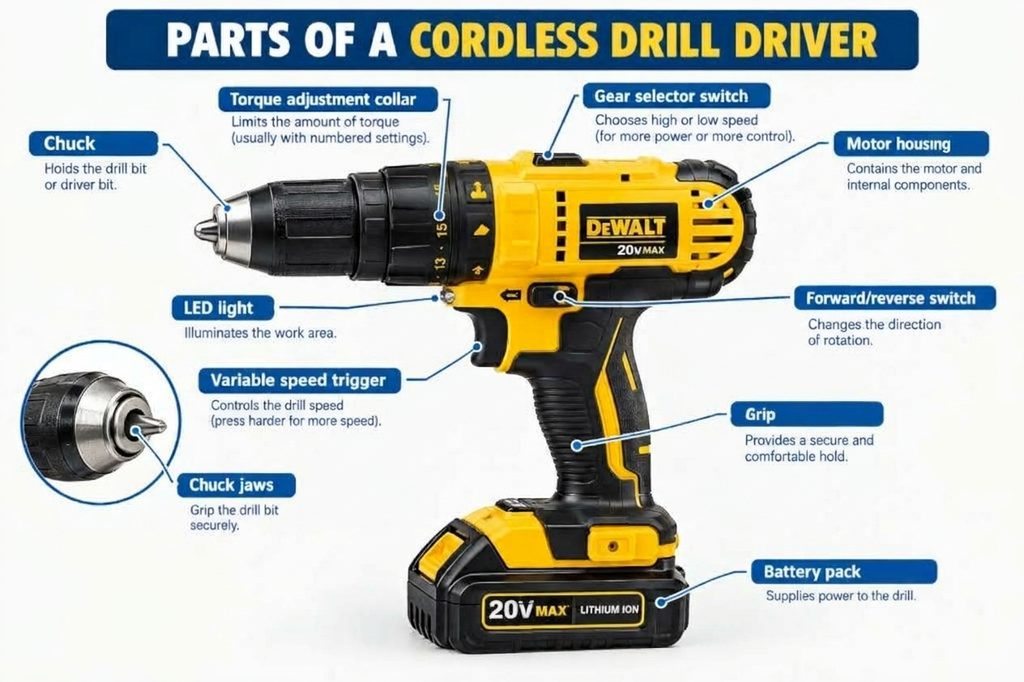
When you press the trigger, electrical power from the battery or outlet reaches the motor, which turns a gear system that transfers power to the chuck. The chuck securely holds the drill bit and spins it at the selected speed.
Most modern drills have a variable-speed trigger so pressing the trigger harder increases the speed, while releasing it slows or stops the tool.
A drill’s gear selector controls the speed and torque range while the adjustable clutch helps control how much torque reaches the bit when driving screws. Lower-speed settings generally provide more torque, while higher-speed settings are suited to faster drilling.
The forward/reverse switch changes the direction of bit rotation, making it possible to drive or remove screws. Some drills also include a hammer mode which adds a rapid hammering action for drilling into masonry.
In simple terms, the motor creates the rotation, the gears control the speed and torque, the chuck holds the bit, and the trigger controls the operation. When these components work together, the drill converts electrical power into controlled rotational motion that you can use for drilling and fastening.
Drill Types and Features Explained: a 2026 Buyer’s Guide
A. General-Purpose Drilling
1. Drill/Driver
A drill/driver is the general-purpose drill most homeowners encounter. It combines two common jobs:
- Drilling holes.
- Driving screws and other fasteners.
A drill/driver normally uses a chuck that holds a wide range of drill bits and screwdriver bits. Cordless drills have adjustable clutches that help control how much torque is delivered when driving screws, which can help prevent overdriving or damaging screw heads. In cordless drills, torque has a reverse role with speed.
- low speed with higher torque for larger bits and demanding fastening
- higher speed with lower torque for smaller-diameter drilling
| The Chuck | Hold the drill bit in place. Accepts a variety of bit sizes and types through its adjustable jaws. |
| The Clutch | An adjustable torque limiter. When the drill meets a set level of resistance, the clutch disengages the drive stopping the bit from turning. This prevents over-driving screws, stripping heads, or sinking fasteners too deep in soft materials. |
For everyday home projects, a drill/driver can handle jobs such as:
- Drilling holes in wood, plastic, some metals with the appropriate bit
- Installing shelves, cabinet hardware
- Hanging hardware
- Assembling furniture
- Driving screws
- General DIY repairs
This is why the drill/driver is often treated as the general-purpose starting point within the drill category.
2. Cordless Drill
A cordless drill runs from a rechargeable battery.
Its biggest advantage is mobility. You do not need to stay near an electrical outlet, making it convenient for construction, home improvement, repairs, and work around a job site.
Brands have their unique battery system for cordless tools. Such as:
- Milwaukee drills follow M12/ M12 FUEL, M18/ M18 FUEL, M28/ M28 FUEL battery system
- DeWalt drills follow 12V MAX, 12V MAX XTREME, 20V MAX, 20V MAX XTREME, XR,FLEXVOLT
- Makita drills follow 12V max CXT, 18V LXT, 40V max XGT. Etc.
3. Corded Drill
A corded drill receives continuous electrical power from an outlet.
Instead of stopping to recharge a battery, you can continue working as long as electricity is available. This can be useful for longer jobs or situations where continuous operation matters more than mobility.
Cordless Vs. Corded Drill
The clutch is one of the key features that separates cordless drills from their corded counterparts and it explains why the two types are best suited to different tasks.
| Feature | Cordless Drill | Corded Drill |
|---|---|---|
| Clutch control | Yes. Adjustable torque settings | Almost never |
| Torque delivery | Adjustable, clutch-controlled | Constant. Cannot be limited |
| Best for | Driving holes & fasteners | Drilling holes |
| Risk when driving | Low. Clutches out at set limit | High. Easily cams out or overdrives |
| Power source | Battery (18V, 20V, etc.) | Wall outlet, unlimited runtime |
Why Corded Drills Struggle With Fasteners?
Corded drills apply a constant, unregulated amount of torque at variable speeds. Without a clutch to disengage at a set resistance, there is nothing to stop the bit from camming out of a screw head or sinking a fastener too deep.
For drilling holes where consistent torque is an asset, corded drills excel. For driving screws, a cordless drill with clutch control is the right tool.
Simple difference:
Cordless = mobility.
Corded = continuous power.
Neither is automatically the right choice for every user. The better fit depends on how and where you work.
B. Screwdriving and Fastening
General drill driver, impact driver & screw gun are used for screwdriving and fastening.
Can a Drill Drive Screws?
Yes.
A drill/driver can drive screws using an appropriate screwdriver bit. Its adjustable clutch is particularly useful because you can select a lower or higher torque setting depending on the job.
This is useful when working with:
- Furniture
- Cabinets
- Shelves
- Small screws
- Hardware
- General household repairs
The clutch can help prevent the screw from being driven too deeply and can reduce the chance of damaging the screw head.
Why Would I Need an Impact Driver?
An impact driver is designed primarily for fastening.
Instead of relying only on continuous rotation, it adds rotational impacts when the fastener encounters resistance. These repeated impacts increase the rotational force available to the fastener.
That makes an impact driver useful for jobs such as:
- Long screws
- Lag screws
- Deck construction
- Fence construction
- Dense wood
- Repetitive fastening
- Other high-resistance fastening tasks
An impact driver normally uses a 1/4-inch hex interface, rather than the chuck commonly found on a drill/driver. That’s why impact drivers need different bits.
Bits for Impact Driver:
- PH1/PH2/PH3 impact bits
- T20/T25/T30 impact bits
- PZ1/PZ2/PZ3 impact bits
- Robertson/Square bits
- Hex bits
- Impact nut drivers
- Socket adapters
- Impact-rated drill bits
- Step drill bits designed for impact drivers
Internal Mechanism of Impact Driver
Unlike a drill’s constant torque, the impact driver uses a hammer-and-anvil mechanism inside the tool body. Under normal load it spins like a drill. When it meets heavy resistance, the hammer strikes the anvil in rapid rotational bursts multiplying the force delivered to the fastener without transferring the counterforce to your wrist.
This is also why impact drivers use a hex chuck rather than a standard chuck — the torque generated would cause a standard chuck to loosen during use.
What Is a Screw Gun Used For?
A screw gun is designed specifically for driving screws, often at high speed and to controlled depths. This makes screw guns useful when a project involves installing a large number of screws repeatedly.
Drywall installation is one example where this type of tool can be useful because consistent screw depth matters.
Unlike a general-purpose drill/driver, the screw gun is more specialized toward screwdriving.
Screw Gun vs Impact Driver
A screw gun focuses on speed and consistent depth, while an impact driver focuses on torque and driving power.
Small or delicate screw at high speed and continuous controlled depths → Screw Gun
Long screws, decking, framing, dense materials, or high-torque fastening → impact driver
C. Masonry and Concrete Drilling
For tough materials like masonry (stone, brick, concrete blocks, plastering) hammer drill, rotary hammer drill & core drill are used.
Is a Hammer Drill Enough for Concrete?
A hammer drill combines normal rotation with a hammering action that moves the bit forward and backward while it rotates.
This additional hammering action helps the bit work into masonry materials such as:
- Brick
- Concrete block
- Masonry
- Some concrete applications
For light or smaller masonry holes, a hammer drill can be appropriate. However, heavier concrete drilling is a different situation.
Hammer Drill – How it Works?
The hammer drill adds a physical hammering motion to the spinning bit. Rather than just cutting, the bit is also being driven forward in rapid pulses pulverizing the masonry surface as it rotates. This combination dramatically speeds up drilling through concrete, brick, and stone compared to a standard drill.
When Do I Need a Rotary Hammer?
A rotary hammer provides a substantially stronger hammering action than a conventional hammer drill. It is designed for more demanding masonry and concrete work.
A rotary hammer is useful when you regularly need to:
- Drill larger holes in concrete
- Drill deeper holes
- Work with harder masonry
- Perform repeated concrete drilling
Hammer Drill vs Rotary Hammer
| Feature | Hammer Drill | Rotary Hammer |
| Rotation | Yes | Yes |
| Axial hammering | Yes | Yes |
| Impact strength | Lower | Much higher |
| Typical use | Light masonry drilling | Heavy concrete/masonry |
| Home DIY | Common | More specialized |
| Heavy concrete work | Limited compared with rotary hammer | Designed for it |
The important difference is the level of impact energy. If you are only occasionally making small holes in brick or masonry, a hammer drill may be sufficient. Repeated or heavier concrete work points toward a rotary hammer.
When Do I Need a Core Drill?
A core drill is used when you need a large-diameter opening rather than a normal small hole.
Core drills can use specialized core bits including diamond core bits, for applications involving:
- Concrete
- Reinforced concrete
- Masonry
- Plumbing openings
- HVAC installations
- Electrical work
Think of it this way:
Normal drill → small/general holes
Hammer drill → normal concrete drilling
Rotary hammer → heavy concrete drilling
Core drill → large-diameter openings
D. Precision Drilling
Drill press and magnetic drill are used for precision drilling.
Why Is My Drill Hole Not Straight?
Holding a handheld drill perfectly perpendicular to a workpiece can be difficult. Even if your technique is good, the tool can move slightly as you drill.
If you need highly consistent, straight perpendicular & repeatable holes, a drill press is designed for this type of work.
When Should I Use a Drill Press?
A drill press holds the drilling mechanism in a fixed structure and allows greater control over:
- Hole position
- Drilling angle
- Depth
- Spindle speed
- Repeatability
This makes it useful when accuracy matters more than portability.
Typical applications include:
- Workshop projects
- Woodworking
- Metalworking
- Repeated holes
- Precise drilling operations
Drill Press vs Handheld Drill
| Feature | Handheld Drill | Drill Press |
| Portability | High | Low |
| Precision | Depends heavily on user | Higher repeatability |
| Straight holes | User-controlled | Machine-controlled |
| Repeated holes | More difficult | Easier |
| Job-site work | Excellent | Limited |
| Workshop work | Good | Excellent for precision |
If you simply need to hang a shelf, you probably do not need a drill press. If you need dozens of identical, straight holes, the difference becomes much more important.
What Is a Magnetic Drill Used For?
A magnetic drill, often called a mag drill, is designed for drilling metal particularly structural steel.
It uses a magnetic base to attach itself to the metal workpiece while drilling.
This makes it useful for applications involving:
- Structural steel
- Steel fabrication
- Large metal components
- Heavy fabrication work
Magnetic drills can also use specialized cutters such as annular cutters, which remove a ring of material rather than grinding away the entire center of the hole.
Magnetic Drill Chuck
Weldon shank is common on magnetic drills.
A common size is: 3/4-inch Weldon shank
Used with annular cutters and other magnetic-drill tooling.
Magnetic Drill vs Drill Press
A drill press provides controlled stationary drilling in a workshop.
A magnetic drill is designed to bring that type of specialized drilling capability directly to large steel structures.
E. Confined-Space Drilling
What Drill Works in Tight Spaces?
Sometimes the problem is not power or speed. The problem is space.
A standard drill can be difficult to position when there is not enough room around the workpiece.
A right-angle drill changes the orientation of the tool so that the drilling mechanism sits at approximately 90 degrees to the handle.
This makes it useful in confined spaces such as:
- Between studs
- Inside cabinets
- Around framing
- Tight construction areas
- Plumbing and electrical work
The main reason to choose a right-angle drill is therefore access, not simply more power.
F. High-Torque and Large-Hole Drilling
D-handle drills & spade-handle drills are used for high torque, easy handling & more control.
Why Do Large Drill Bits Create So Much Torque?
Large drill bits and hole saws can require substantially more force to rotate through a material.
If the bit catches or encounters significant resistance, the drill can react against the user’s hands. This is where specialized high-torque drills become useful.
Do I Need a D-Handle Drill?
A D-handle drill provides a different grip arrangement designed to improve handling and control when working with substantial torque.
The handle configuration gives the user a more secure way to hold the tool during demanding drilling operations.
These drills are more specialized than a normal household drill/driver.
What Is a Spade-Handle Drill Used For?
A spade-handle drill is designed for high-torque, lower-speed drilling applications.
It can be useful with accessories such as:
- Large augers
- Self-feed bits
- Large hole saws
- Other large-diameter drilling accessories
They are particularly relevant when drilling large holes in materials such as timber.
The important distinction is that D-handle drills & spade-handle drills are designed around high torque and control rather than simply being a more powerful version of an everyday drill/driver.
G. Industrial Power Sources
What Is a Pneumatic Drill?
A pneumatic drill is powered by compressed air rather than electricity or a battery.
They can provide a useful power-to-weight ratio and are commonly associated with industrial applications such as:
- Automotive work
- Manufacturing
- Aviation
- Aerospace
- Repetitive drilling
The limitation is that you need an appropriate compressed-air system such as an air compressor.
For a typical homeowner, a cordless or corded drill is usually a more straightforward solution unless compressed air is already part of the workshop.
H. Manual and Specialized Drilling
What Is a Hand Drill?
A hand drill is operated manually rather than using an electric motor or compressed air.
Traditional hand drills and braces can still be useful when:
- Electricity is unavailable
- Battery power is unnecessary
- Low-speed control matters
- You are working with traditional woodworking techniques
They are fundamentally different from modern powered drills because the user’s physical effort provides the drilling motion.
What Features Should I Look for in a Drill?
Once you know which type of drill you need, the next question is which features actually matter.
1. Chuck Size
The chuck holds the drill bit or accessory. A drill chuck size refers to the maximum diameter of a drill bit shank that the chuck’s internal jaws can hold.
Common chuck sizes include:
- 1/4 inch – Found on light duty drills & driver.
- 3/8 inch – Mostly used on compact or household drills; handles basic drilling and a wide variety of everyday bits.
- 1/2 inch – The most common size for general-purpose drills and heavy-duty corded/cordless drills.
A larger chuck can accommodate larger accessories, while smaller chucks are common on compact tools.
3/8-inch chuck
Common on:
- Compact cordless drills
- Light-duty drills
- Small pneumatic drills
- Older/general-purpose drills
Typical accessories:
- Twist bits
- Brad-point bits
- Small spade bits
- Driver bits
- Small hole saws
Typical shank range: 1/16″ → 3/8″
1/2-inch chuck
Common on:
- Full-size cordless drills
- Hammer drills
- Heavy-duty drills
- Right-angle drills
- Joist drills
- Corded drills
Common accessories:
- Twist bits
- Masonry bits
- Spade bits
- Auger bits
- Forstner bits
- Hole saws
- Step bits
- Countersinks
- Driver bits
Maximum straight shank: 1/2 inch
Do not choose a drill only because it has the largest chuck. Choose a size appropriate for the accessories and work you actually expect to use.
Drill chuck size vs drill-bit size
A 1/2-inch chuck does NOT mean the drill only drills 1/2-inch holes.
It means the chuck can accept a bit with a shank up to approximately 1/2 inch in diameter. A hole saw or other accessory can make a much larger hole if its shank fits the chuck and the drill is rated for the application.
For example:
1/2-inch chuck → 1/2-inch straight-shank bit
But you can potentially drill a larger hole using:
- Spade bits
- Hole saws
- Step bits
- Forstner bits
- Auger bits
- Core bits
depending on the drill’s specifications and the accessory’s shank.
2. Chuck Type: Keyed vs Keyless
A keyed chuck uses a separate chuck key to tighten and loosen the jaws around the drill bit. The key engages the chuck’s gear mechanism, allowing the user to apply substantial clamping force to the accessory.
Keyed chuck is often found on heavier-duty drills, drill presses and older drills.
A keyless chuck allows you to tighten and release the jaws by hand without using a chuck key.
This is now extremely common on cordless drills and drill/drivers because it makes changing bits quick and convenient.
| Feature | Keyed Chuck | Keyless Chuck |
| Bit changes | Slower | Faster |
| Chuck key | Required | Not required |
| Convenience | Lower | Higher |
| Bit clamping | Strong and adjustable | Strong on quality designs |
| Everyday DIY | Good | Excellent |
| Construction | Good | Excellent |
| Heavy-duty drilling | Very useful | Depends on chuck/tool design |
| Frequent bit changes | Less convenient | More convenient |
Choose a Keyed Chuck If:
When you want secure bit clamping and heavy-duty drilling are more important than quick bit changes. .
Choose a Keyless Chuck If:
You want fast bit changes and a convenient general-purpose drill.
For many modern drill/driver users, a quality keyless chuck is the practical choice.
What’s SDS-Plus and SDS-Max?
SDS system is a specialized tool-holding system used primarily on rotary hammers. The two systems most commonly encountered today are SDS-Plus and SDS-Max. An SDS system is different from a conventional three-jaw drill chuck.
Instead of tightening jaws around a round-shank bit, an SDS rotary hammer uses a specialized tool holder that accepts SDS-shank accessories.
The bit slides into the holder and locks through grooves in its shank. The design allows the bit to move axially during hammer drilling while remaining engaged with the drive mechanism.
This makes SDS systems particularly useful for concrete, masonry, drilling, and chiseling applications.
SDS-Plus
Used primarily on rotary hammers for:
- Concrete
- Brick
- Masonry
- Chiseling
Accessories:
- SDS-Plus masonry bits
- SDS-Plus core bits
- Chisels
SDS-Max
Used for:
- Heavy concrete drilling
- Large masonry holes
- Demolition
- Large core bits
Accessories:
- Large masonry bits
- Core bits
- Chisels
- Scaling tools
For ordinary household drilling, you may never need either. They become much more relevant when your work involves serious masonry or concrete drilling.
| SDS System | Typical Tool Class | Typical Applications |
| SDS-Plus | Smaller rotary hammers | Anchors, masonry, concrete drilling, light-to-medium construction |
| SDS-Max | Larger rotary hammers | Large holes, heavy concrete drilling, chiseling, demolition |
3. Adjustable Clutch
One of the most common beginner questions is: “What are all those numbers on my drill for?” The answer is torque control — and understanding it is key to driving fasteners cleanly without stripping or overdriving them.
What Are the Numbers? (The Clutch/ Slip Clutch/ Torque Control)
The moveable collar near the chuck of a cordless drill is called the clutch control, slip clutch, or torque control. The numbers on it represent torque settings — they let you control how much rotational force the drill applies before it disengages.
Torque vs. Speed(RPM)
Torque is how hard the drill fights to keep the bit spinning against resistance. Speed is simply how fast the bit spins. A drill can spin very fast but still stall if it lacks sufficient torque. You need both working together for efficient drilling and driving.
When the clutch setting is reached, the drill “clutches out” — it disengages the drive mechanism before the bit can damage the fastener or sink it too deep. This prevents two common problems:
- Cam out — the bit slips out of the screw head, chewing up the drive recess
- Overdriving — the screw sinks too far, breaking through drywall paper or splitting wood
How to Set the Clutch
| Low | Soft materials / small screws | Use low numbers for drywall screws, hobby screws, or soft woods where over-driving is easy. |
| Mid | General fastening | A mid-range setting works for most everyday screw driving into standard lumber. |
| High | Dense materials / large fasteners | Higher settings for hardwoods, long screws, or materials that offer significant resistance. |
| Drill icon | Drilling holes | The drill bit symbol at the top of the range keeps torque fully engaged for high-speed hole drilling. Not for driving fasteners. |
| Hammer icon | Hammer drill mode | On combination drills, the hammer symbol activates the hammer drill function for masonry. Separate from the torque settings. |
This is one reason a drill/driver can provide more controlled screwdriving than a tool designed primarily for high-torque fastening.
4. Variable Speed
Variable-speed control allows you to adjust how quickly the drill rotates. Different materials and accessories can require different speeds.
For example, you may want more control at lower speeds when starting a hole or working with certain materials and accessories.
The important point is that more speed is not automatically better.
5. Brushless Motor
A brushless motor uses electronic control instead of traditional carbon brushes for commutation. Brushless drills are common in modern cordless tool systems.
Potential benefits include improved efficiency, reduced brush wear, and longer operating life under appropriate conditions.
However, motor type should be considered alongside the entire tool’s design, workload, battery system, and price rather than treated as the only measure of quality.
6. Bit Types
Metal/general drilling
- Twist drill bit
- Cobalt drill bit
- HSS drill bit
- Titanium-coated drill bit
- Step drill bit
Wood drilling
- Brad-point bit
- Spade bit
- Auger bit
- Forstner bit
- Self-feed bit
- Hole saw
Masonry
- Masonry drill bit
- Carbide-tipped masonry bit
- SDS-Plus bit
- SDS-Max bit
- Diamond core bit
Fastening
- Phillips bit
- Pozidriv bit
- Torx bit
- Hex bit
- Robertson/Square bit
- Slotted bit
- Nut-driver bit
How Do I Choose a Drill for My Material?
The material you are drilling should be one of your first selection criteria.
Wood
For normal wood drilling, a drill/driver is usually the starting point.
For very large holes, high-torque drills such as spade-handle models may become useful.
Metal
A suitable drill/driver can handle many metal-drilling applications when paired with the correct bit and operating speed.
For structural steel and specialized fabrication, a magnetic drill may be more appropriate.
Masonry
A hammer drill adds an axial hammering action that helps with masonry drilling.
Concrete
For more demanding concrete drilling, a rotary hammer provides substantially stronger hammering action.
For large-diameter concrete openings, a core drill is a specialized option.
Can One Drill Do Everything?
Not really.
A drill/driver is versatile, but different drilling problems require different tool designs.
This is why simply asking “What is the most powerful drill?” is not the best way to choose a tool.
The better question is:
What am I trying to drill, how large is the hole, how often will I do it, and how much control or access do I need?
Match the Tool to the Task
| Task | Best tool | Why |
| Drilling into brick or block | Hammer drill (occasional) or rotary hammer (frequent/larger holes) | Needs linear impact to fracture masonry |
| Drilling into ceramic tile | Standard drill, hammer function off, with a tile/glass bit | Hammer action risks cracking tile, especially over voids |
| Drilling further into brick after tile | Hammer drill, hammer function on | Once through the tile, impact is safe and effective |
| Furniture assembly | Drill/driver or impact driver | Light torque, small fasteners; either works fine |
| General woodworking / pilot holes | Standard drill or drill/driver | No impact needed; precision and control matter more |
| Driving long screws into wood/MDF/particleboard | Impact driver | Rotational impact prevents cam-out and wrist strain on longer fasteners |
| Un/mounting lug nuts | Impact wrench | Needs far more torque than a driver provides |
| Precise, repeatable holes | Drill press | Only stationary tools guarantee consistent depth and angle |
Which One Drill if I Can Only Own One?
A hammer drill with a standard chuck and a switchable hammer function. It drills wood, metal, and plastic like a normal drill/driver, handles occasional masonry work, and drives screws reasonably well — not as smoothly as a dedicated impact driver, but adequately for most household needs. It’s the one tool that covers the widest range of the tasks above without forcing a compromise on any single one. If your work leans heavily toward driving lots of fasteners, pairing that hammer drill with an inexpensive impact driver covers nearly everything a homeowner or serious DIYer will run into.
Final Takeaway: Choose the Drill Around the Job
There is no single drill designed to be ideal for every drilling situation.
A drill/driver is the general-purpose option for everyday drilling and screwdriving. An impact driver is designed around high-resistance fastening. A hammer drill adds axial hammering for masonry, while a rotary hammer is designed for more demanding concrete work.
For specialized jobs, the tool changes again: drill presses prioritize precision, magnetic drills target structural steel, right-angle drills solve access problems, and spade-handle or D-handle drills provide control for high-torque applications.
