
Choosing a cordless drill is not only about the drill itself. The battery affects how long you can work, how much power the tool can deliver, how heavy it feels, and whether you can use the same battery with your other tools.
If you are buying your first cordless drill, you may see terms such as 12V, 18V, 20V MAX, 2Ah, 4Ah, 5Ah, lithium-ion, fast charging, battery platform, and brushless.
What do they mean?
More importantly, which one actually matters for your work?
This guide explains cordless drill batteries in simple terms. It covers amp hours, battery charging, voltage, battery platforms, compatibility, and the major battery systems from brands such as Milwaukee, DEWALT, Makita, Bosch, Ryobi, and Metabo HPT.
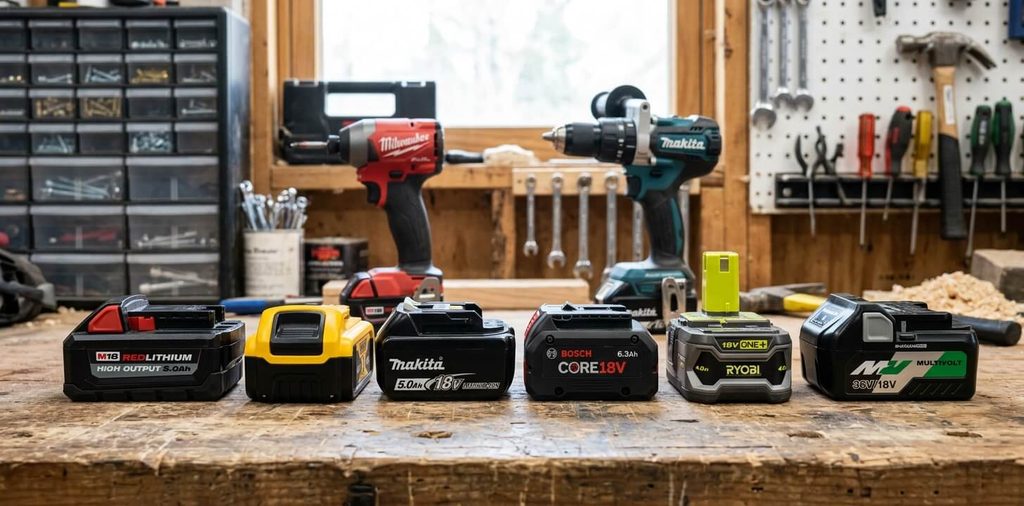
What Is a Cordless Drill Battery?
A cordless drill battery is a rechargeable power pack that supplies electrical energy to the drill’s motor and electronics.
Most modern cordless drills use lithium-ion (Li-ion) battery packs. The pack contains multiple cells connected together with electronic controls that monitor and manage the battery.
The battery does more than simply store electricity. The battery system can communicate with the tool and charger to help manage:
- Power delivery
- Temperature
- Charging
- Overload protection
- Over-discharge protection
- Battery condition
- Remaining charge
This is why you should think about the battery and drill as one system, rather than treating the battery as a simple replaceable power source.
What Does Amp Mean on a Cordless Drill Battery?
When people say “amp” while discussing cordless drill batteries, they often mean amp-hours (Ah).
These are not the same thing.
Amp (A) vs Amp-Hour (Ah)
Amp (A) measures electrical current.
Amp-hour (Ah) measures battery capacity.
For example:
- 2Ah
- 3Ah
- 4Ah
- 5Ah
- 6Ah
- 8Ah
are battery-capacity ratings.
A simple way to understand Ah is:
Higher Ah generally means the battery can provide energy for longer, assuming the same voltage and similar operating conditions.
It does not automatically mean that the drill becomes twice as powerful.
For example, a 5Ah battery can generally provide more energy over time than a 2Ah battery on the same battery platform.
However, actual runtime depends on the drill, workload, material, battery condition, temperature, and how continuously you use the tool.
Voltage vs Ah: What Is the Difference?
This is where many first-time cordless-tool buyers get confused.
Voltage tells you the electrical class. Think of voltage as how hard the battery can push electricity into the drill’s motor.
Common cordless drill battery ratings include:
- 12V
- 18V
- 20V MAX
- 24V
- 36V
- 40V MAX
Ah tells you the capacity. Think of Ah as how much energy the battery can store and deliver over time.
Common battery capacities include:
- 1.5Ah
- 2.0Ah
- 3.0Ah
- 4.0Ah
- 5.0Ah
- 6.0Ah
- 8.0Ah
- 10.0Ah
- 12.0Ah
Think of it this way:
Voltage = Electrical push available to the tool (Water pressure)
Ah = Battery capacity (Water tank size)
Battery platform = compatibility
For example, an 18V 5Ah battery and an 18V 2Ah battery belong to the same voltage class, but the 5Ah battery has greater capacity.
Should I Buy a Bigger Ah Battery?
It depends on what you do.
Choose a Smaller Ah Battery When You Want:
- Lower weight
- Better balance
- Easier overhead work
- Less hand fatigue
- Compact size
- Shorter jobs
Choose a Larger Ah Battery When You Want:
- Longer runtime
- Fewer battery changes
- More energy for demanding work
- Longer continuous operation
For example, a compact 2Ah battery can make sense for a drill used around the house.
A 5Ah or larger battery can make more sense when the same platform powers saws, grinders, or other high-demand tools.
But bigger does not always mean better. A large battery can add noticeable weight to a compact drill.
| Use case | Battery choice to consider |
| Occasional household drilling | 1.5–2.0Ah |
| Furniture assembly | 2.0–3.0Ah |
| General DIY | 2.0–5.0Ah |
| Construction work | 4.0–6.0Ah |
| Heavy drilling | 5.0–8.0Ah |
| Long continuous work | High-capacity/high-output battery |
| Overhead work | Smaller, lighter battery |
| High-load applications | High-output battery |
These are general selection guidelines, not strict rules. The correct battery also depends on the drill’s design and the manufacturer’s recommendations.
Does a Higher Ah Battery Give a Cordless Drill More Power?
Not necessarily. This is one of the most common battery misunderstandings.
Think of the ratings this way:
Voltage tells you about the electrical potential of the battery system. Ah tells you about its capacity.
A larger Ah battery primarily gives you more available energy and often longer runtime. However, the battery’s internal design can also affect how much current it can deliver to a demanding tool.
That is why two batteries with the same voltage and similar Ah ratings can still perform differently.
Modern manufacturers also develop higher-performance battery packs with improved cells, electronics, thermal management, and construction.
Milwaukee, for example, currently offers different M18 REDLITHIUM battery tiers, including standard REDLITHIUM, HIGH OUTPUT, and FORGE. Milwaukee states that its HIGH OUTPUT packs provide more power and lower operating temperatures than standard packs, while FORGE is positioned as its highest-performance REDLITHIUM tier.
How Does Battery Voltage Affect a Cordless Drill?
Common cordless drill battery systems include:
- 12V
- 18V
- 20V MAX
- 36V
- 40V and higher in larger cordless equipment
For drills, 12V and 18V/20V systems are especially common.
A 12V drill is usually designed for compact, lighter-duty work.
An 18V or 20V MAX drill generally supports a broader range of demanding applications.
For example:
12V
A compact 12V drill can be useful for:
- Assembling flat-pack furniture
- Installing cabinet knobs, pulls, hinges and curtain rods and blinds
- Pre-drilling small holes for wood screws
- Drilling small pilot holes in softwood
- Driving screws into plywood and thin boards
- Installing electrical boxes and faceplates
- Installing drawer slides
- Light screwdriving
- Building small shelves and storage units
- Installing door handles and light hardware
- Working inside cabinets and other tight spaces, ETC.
18V/20V MAX
An 18V or 20V MAX drill can be useful for:
- Drilling large holes through wood for plumbing pipes
- Drilling holes for electrical cable runs
- Driving long screws into framing lumber
- Building decks and fences
- Installing structural wood screws
- Drilling through hardwood
- Installing heavy-duty shelving
- Building pergolas and outdoor structures
- Drilling through thicker metal with appropriate bits
- Installing large door hardware
- Drilling holes for pipe and conduit
- Repeated drilling and screwdriving on renovation projects
- Drilling masonry with a suitable hammer-drill model and masonry bit
The trade-off is usually size and weight. Larger batteries and tools can provide more capability but can also make the tool heavier.
Are 18V and 20V MAX the Same?
In many major tool systems, 18V nominal and 20V MAX refer to the same basic five-cell lithium-ion class.
DEWALT explains that its 20V MAX batteries have a 20V maximum initial voltage without a workload and 18V nominal voltage.
You should not assume that a “20V MAX” label automatically means the tool is more powerful than every 18V tool.
The complete system matters:
battery + cells + electronics + motor + tool design + workload
all influence performance.
What Is a Battery Platform?
A battery platform is a manufacturer’s battery ecosystem in which compatible batteries can power a range of tools.
Instead of buying a separate battery and charger for every tool, you can buy several bare tools and move batteries between compatible products.
For example, a battery platform might include:
- Drills
- Impact drivers
- Circular saws
- Reciprocating saws
- Sanders
- Grinders
- Lights
- Vacuums
- Outdoor power tools
Battery platform is one of the most important things to consider when buying your first cordless drill.
Why Does the Battery Platform Matter?
Imagine you buy a cordless drill today.
Six months later, you want an impact driver.
A year later, you want a circular saw.
If all three tools use the same battery platform, you may only need to buy the bare tool for the second and third purchases. That can reduce the number of batteries and chargers you need.
Makita currently states that LXT has 350+ compatible solutions, while RYOBI says ONE+ has remained compatible as it moved from Ni-Cd to lithium-ion and now has 300+ compatible products.
Battery Compatibility: Does the Same Voltage Mean the Battery Will Fit?
No.
This is an important beginner mistake.
Two batteries can both be labeled 18V and still belong to completely different battery platforms.
For example:
- Milwaukee M18 is not the same platform as Makita LXT.
- Makita LXT is not the same platform as Bosch Professional 18V.
- Bosch Professional 18V is different from Ryobi ONE+ 18V.
The battery needs to match the tool’s:
- Physical connection
- Voltage system
- Electronics
- Communication system
- Battery platform
So do not buy a battery simply because the voltage number looks correct. Always check the tool manufacturer’s compatibility information.
Cordless Drill Battery Charging Explained
Charging a cordless drill battery is more than plugging it into a wall outlet.
The charger and battery work together to control the charging process.
Modern battery systems can monitor things such as:
- Battery temperature
- Cell voltage
- Charging status
- Battery condition
- Charge rate
The charger then adjusts the charging process according to the battery and charger design.
Milwaukee, for example, says its REDLINK system allows communication between the battery, charger, and tool. Its chargers monitor conditions such as cell voltage, temperature, and charge status to optimize charging.
How Long Does a Cordless Drill Battery Take to Charge?
There is no single charging time for every cordless drill battery.
Charging time depends on:
- Battery capacity
- Battery technology
- Charger output
- Battery temperature
- Charger design
- Battery condition
A larger battery can require more energy to reach full charge. A more advanced charger can reduce the waiting time.
For example, Milwaukee states that charging time depends on the battery, charger, and surrounding conditions. Its M18 Super Charger can charge an M18 REDLITHIUM FORGE XC6.0 battery to full in about 25 minutes under its stated test conditions.
Metabo HPT also offers rapid charging for its MultiVolt batteries. Its current 10Ah/5Ah MultiVolt battery lists different charge times depending on the charger used.
Does Fast Charging Damage a Cordless Drill Battery?
Fast charging increases the rate at which electrical energy enters the battery, so heat management becomes important.
Modern battery systems use electronics and thermal management to control this process.
For example, Milwaukee says its Super Charger communicates with the battery and adjusts the charge rate based on the battery pack.
This means you should use the charger designed for your battery platform rather than experimenting with incompatible chargers.
Milwaukee specifically advises using authentic M18 batteries with Milwaukee M18 chargers and not using third-party batteries or chargers.
Can You Leave a Cordless Drill Battery on the Charger?
Do not treat the charger as a permanent storage device.
Milwaukee says its batteries stop charging after reaching full capacity and that REDLINK electronics provide overcharge protection, but Milwaukee still recommends unplugging chargers and removing batteries when they are not in use.
For long-term storage, follow the instructions in the battery’s manual.
Also avoid storing batteries in extreme heat, excessive moisture, or other conditions outside the manufacturer’s recommendations.
Why Does My Cordless Drill Battery Run Out So Fast?
A battery that seems to drain quickly does not always mean the battery is defective.
Runtime can change because of:
- Battery age
- Battery capacity
- Heavy drilling
- Large drill bits
- Dense materials
- Continuous operation
- High temperatures
- Cold temperatures
- Battery condition
- Tool efficiency
- Motor design
A small 2Ah battery will normally provide less total runtime than a larger battery of the same voltage and comparable technology.
A cordless drill may stop unexpectedly even when the battery indicator appears to show charge remaining. That can happen when the tool or battery protection system responds to operating conditions. So “the battery says full” does not always mean the tool can deliver maximum power under every load.
What Happens When a Cordless Drill Battery Gets Old?
Lithium-ion batteries gradually lose capacity and performance with age and use.
You may notice:
- Shorter runtime
- More frequent charging
- Reduced performance under heavy loads
- Unexpected shutdowns
- Longer charging behavior
- Battery overheating
- Physical damage or swelling
Do not open or rebuild a damaged lithium-ion battery pack yourself unless you have the appropriate professional training and equipment.
A damaged battery can present serious electrical and fire hazards.
If a battery is damaged, follow the manufacturer’s safety instructions and use an appropriate battery recycling or disposal service.
Battery Platform Guide: Major Cordless Drill Brands
Different manufacturers have developed their own battery ecosystems.
Some have maintained a platform for many years. Others have added new voltage classes or higher-performance battery generations.
Here is how the major systems compare.
Milwaukee Battery Platform
Milwaukee currently separates its major cordless systems into M12, M18, and MX FUEL.
For cordless drills, the two most relevant systems are:
- M12
- M18
Milwaukee states that M12 batteries work with M12 tools and chargers, while M18 batteries work with M18 tools and chargers.
Milwaukee M12
The M12 system focuses on compact 12V-class tools.
It is useful when size and weight matter.
Milwaukee currently offers a broad M12 ecosystem, and its M12 REDLITHIUM batteries include compact and higher-capacity options.
Milwaukee M18
Milwaukee introduced the M18 system as its professional 18V cordless platform and has maintained compatibility while upgrading its battery technology.
Milwaukee says its M18 system was introduced in 2007 and that its newer battery generations maintain compatibility with M18 tools.
The M18 platform is Milwaukee’s larger 18V-class cordless system.
It covers a wide range of professional tools.
Milwaukee says the M18 system includes more than 250 tools, while its current battery lineup includes standard REDLITHIUM, HIGH OUTPUT, and FORGE batteries.
Milwaukee’s M18 battery evolution
The M18 battery family has progressed through several major generations:
M18 REDLITHIUM → REDLITHIUM HIGH OUTPUT → REDLITHIUM FORGE
Milwaukee introduced REDLITHIUM batteries in 2010 and M18 FUEL tools in 2012.
The company later introduced HIGH OUTPUT batteries to increase power delivery and thermal performance.
Milwaukee’s newer REDLITHIUM FORGE batteries further upgrade the M18 system with newer cell technology, improved pack construction, power routing, thermal management and faster charging.
For example, the current M18 REDLITHIUM FORGE HD12.0 provides 12Ah and Milwaukee says it delivers 50% more power than its M18 HIGH OUTPUT HD12.0.
What Is Milwaukee FUEL?
FUEL is not a separate battery voltage. It is a higher-performance tool technology designation.
Milwaukee says M18 FUEL tools combine three technologies:
- POWERSTATE Brushless Motor
- REDLITHIUM Battery
- REDLINK PLUS Intelligence
The motor provides the mechanical output, the battery provides the energy, and the electronic system manages communication and protection between the components.
This is an important distinction:
All FUEL tools are brushless, but not every Milwaukee brushless tool is necessarily a FUEL tool.
Milwaukee charging
Milwaukee also upgraded its charging system.
M18 REDLITHIUM FORGE batteries work with Milwaukee’s Super Charger system. Milwaukee states that the FORGE XC8.0 and HD12.0 batteries can reach 80% charge in about 35 minutes when paired with the M18 Dual Bay Simultaneous Super Charger under the manufacturer’s specified conditions.
So the upgrade is not just the battery.
It is:
Battery cells + battery electronics + tool electronics + charger + thermal management.
DEWALT Battery Platform
DEWALT previously built a large cordless range around its 18V XRP system. That older platform included NiCd batteries and later 18V lithium-ion options. DEWALT documentation also shows its older 18V XRP tools and batteries.
DEWALT later expanded its 20V MAX lithium-ion platform. In the U.S., DEWALT calls the system 20V MAX; the manufacturer states that its nominal voltage is 18V.
DEWALT’s major cordless ecosystem includes:
- 12V MAX
- 20V MAX
- FLEXVOLT
DEWALT currently lists 20V MAX, 20V MAX XR, FLEXVOLT, and 12V MAX as its cordless battery systems.
The important point is that DEWALT did not simply increase the voltage with every generation.
It also improved:
- Lithium-ion technology
- Battery capacity
- Power delivery
- Electronics
- Cell design
- Thermal management
- Charging
- Compactness
DEWALT 20V MAX
The 20V MAX system is DEWALT’s major general-purpose cordless platform.
DEWALT states that 20V MAX batteries have a 20V maximum initial voltage and 18V nominal voltage.
The platform has expanded into drills, impact drivers, saws, grinders, outdoor tools, and many other products.
DEWALT XR
XR represents a higher-performance range within DEWALT’s 20V MAX system.
It is not a completely separate battery voltage.
DEWALT currently positions its XR POWERSTACK and XR POWERPACK batteries as its best-performing 20V MAX batteries.
DEWALT FLEXVOLT
FLEXVOLT is different because the battery can operate across multiple voltage classes.
DEWALT says FLEXVOLT batteries can power its 20V MAX, 60V MAX, and 120V MAX tools, depending on the battery and tool combination.
This gives DEWALT users a way to use one battery family across lighter 20V MAX tools and higher-power equipment.
Makita Battery Platform
Makita has several battery systems rather than one universal voltage platform.
Its major current systems include:
- CXT — 12V max
- LXT — 18V
- XGT — 40V max
- 80V max XGT — two 40V max batteries
Makita explicitly states that batteries are compatible within their respective platforms. An LXT battery is for LXT tools, while XGT batteries belong to the XGT system.
Makita LXT
18V LXT is one of Makita’s most established cordless platforms.
Makita launched the 18V LXT system in 2005. The original platform used lithium-ion batteries and focused on providing more power and lower weight than older battery technology.
Makita later expanded LXT with higher-capacity batteries and a large tool ecosystem.
Makita offers LXT batteries from:
- 1.5Ah, 2.0Ah, 3.0Ah, 4.0Ah, 5.0Ah, 6.0Ah
Makita states that LXT batteries work across LXT products, including tools using two 18V batteries to create 36V.
Makita XGT
Makita later introduced the 40V max XGT for higher-demand applications.
XGT is not simply a replacement battery that you can put into an LXT tool. It is a separate platform with its own battery and tool compatibility. The current XGT family includes:
- 40V max tools
- 80V max tools using two 40V max batteries
Makita currently lists XGT battery capacities including 2.5Ah, 4.0Ah, 5.0Ah and 8.0Ah.
This brand lists 40V max XGT batteries and tools separately from the 18V LXT system.
So the basic Makita progression is:
18V LXT → expanded LXT ecosystem → 40V max XGT for higher-demand tools
Makita has kept multiple platforms because different tools have different power, size, and application requirements.
Bosch Battery Platform
Bosch has separate consumer and professional battery ecosystems. For professional tools, one of the most important systems is the:
Bosch Professional 18V System
Bosch says its Professional 18V batteries and chargers are compatible with its Professional 18V tools dating back to 2008.
That makes compatibility a major part of Bosch’s platform strategy.
The platform includes batteries such as:
- GBA 18V 2.0Ah
- GBA 18V 4.0Ah
- GBA 18V 5.0Ah
- ProCORE18V
- ProCORE18V+
- EXPERT 18V
Bosch ProCORE18V
Bosch also developed higher-performance ProCORE18V batteries.
Bosch states that ProCORE18V batteries remain compatible with its Professional 18V tools dating back to 2008, although the highest performance from BITURBO tools requires suitable ProCORE18V batteries.
Bosch also says ProCORE18V batteries above 5.5Ah can provide up to 2,000W of equivalent corded power, depending on the tool.
Bosch AMPShare
Bosch has also expanded its professional battery system through AMPShare. AMPShare allows compatible batteries to work across participating professional brands.
Bosch describes AMPShare as a multi-brand 18V battery system for professional trade and industrial tools.
So Bosch’s current professional battery strategy is not only about its own tools. It also extends into a multi-brand ecosystem.
This is different from Bosch’s POWER FOR ALL 18V consumer/DIY system. Bosch explicitly says the Professional AMPShare system and POWER FOR ALL system are not compatible.
Ryobi Battery Platform
Ryobi takes a different approach.
Its best-known cordless ecosystem is:
18V ONE+
The important feature is long-term platform compatibility.
Ryobi says the 18V ONE+ system began in 1996 and maintains compatibility across products from the last three decades.
That means the platform has evolved while maintaining its basic battery compatibility.
Ryobi has also continued to upgrade the battery technology.
For example, Ryobi introduced ONE+ HP performance tools and later introduced EDGE battery technology using tabless lithium-cell technology.
The basic strategy is:
ONE+ compatibility → improved batteries → improved motors and electronics → more capable tools
This makes the battery platform itself an important part of the Ryobi ownership experience.
RYOBI platform progression
1996 Ni-Cd ONE+ → 2007 lithium-ion ONE+ → 2018 ONE+ HP
Metabo HPT Battery Platform
Metabo HPT uses the MultiVolt system. The interesting part is its dual-voltage design.
A MultiVolt battery can operate with compatible:
- 18V tools
- 36V tools
Metabo HPT currently lists batteries that automatically adapt to the tool’s voltage requirement. For example, its current 10Ah/5Ah MultiVolt battery provides 10Ah at 18V and 5Ah at 36V.
Metabo HPT MultiVolt Corded + Cordless
MultiVolt also addresses a problem that many cordless tool users have:
What if the job requires long continuous operation?
Some compatible MultiVolt tools can operate either:
- With a MultiVolt battery
- With an AC adapter
Metabo HPT describes the system as providing both cordless and corded operation. This is especially interesting for high-demand applications where battery runtime could otherwise become a limitation.
The key upgrade is dual-voltage capability, rather than simply replacing 18V with 36V.
Major Battery Platform Comparison
| Brand | Main Drill Battery Platforms | Platform Development |
| Milwaukee | M12, M18 | Expanded M12/M18 ecosystems; REDLITHIUM, HIGH OUTPUT and FORGE battery generations; FUEL integrates motor, battery and electronics |
| DEWALT | 12V MAX, 20V MAX | Expanded 20V MAX; XR performance batteries; FLEXVOLT added multi-voltage capability |
| Makita | CXT, LXT, XGT | 18V LXT launched in 2005; expanded LXT; 40V max XGT added for higher-demand applications |
| Bosch Professional | 18V Professional | Long-running 18V compatibility; ProCORE18V; AMPShare multi-brand expansion |
| Ryobi | 18V ONE+ | ONE+ launched in 1996; platform retained compatibility while battery and tool technology evolved |
| Metabo HPT | MultiVolt 18V/36V | Dual-voltage battery system; compatible tools can offer battery or AC-adapter operation |
The key point is that battery platforms evolve without necessarily replacing the entire ecosystem.
Some brands improve the battery while maintaining backward compatibility. Others introduce a new voltage platform for a different class of tools.
What Has Actually Changed in Cordless Drill Batteries?
Cordless battery technology has changed significantly over time.
Older cordless tools commonly used:
- Nickel-cadmium (Ni-Cd)
- Nickel-metal hydride (Ni-MH)
Modern cordless tools commonly use:
- Lithium-ion (Li-ion)
The change to lithium-ion helped manufacturers build lighter batteries with higher energy density and lower self-discharge than older battery technologies.
Makita’s historical material, for example, describes its 18V LXT lithium-ion batteries as 40% lighter than traditional 18V Ni-Cd batteries and highlights their five-times-lower self-discharge.
But battery development did not stop with lithium-ion.
Manufacturers now improve:
- Battery cells
- Cell arrangement
- Thermal management
- Electronics
- Charging systems
- Communication between battery and tool
- Physical protection
- Power delivery
- Battery capacity
That is why a modern 5Ah battery is not simply “the same battery but bigger” compared with an older battery generation.
Why Brushless Motors and Batteries Work Together
A cordless drill’s battery does not work alone.
The motor and electronics also affect how efficiently the tool uses the available energy.
A brushless motor uses electronic control instead of carbon brushes for commutation.
This can reduce mechanical brush wear and can improve efficiency and control in suitable tool designs.
Milwaukee’s FUEL system demonstrates how manufacturers increasingly design the motor, battery, and electronics as an integrated system. Milwaukee’s POWERSTATE brushless motor, REDLITHIUM battery, and REDLINK PLUS intelligence work together as part of its FUEL architecture to manage power, performance, runtime, and protection.
This explains why you should not judge a cordless drill only by its battery voltage.
A complete cordless system can include:
Battery → electronics → motor → gearbox → chuck → accessory
Each part affects the final result.
Should I Buy 12V or 18V/20V for a Cordless Drill?
Ask yourself three questions.
1. What do you drill?
If you mainly drill small holes and drive ordinary screws, a compact 12V system may cover your needs.
If you regularly drill larger holes, work in dense materials, or use the tool heavily, an 18V/20V platform gives you a broader range of capability.
2. How often do you use it?
For occasional household work, weight and convenience may matter more than maximum output.
For frequent construction or workshop use, the larger platform may make more sense.
3. What other cordless tools will you buy?
This may be the most important question.
If you plan to buy:
- Drill
- Impact driver
- Circular saw
- Reciprocating saw
- Grinder
- Sander
- Outdoor tools
then choosing one compatible battery platform can simplify your tool collection.
What Should You Check Before Buying a Cordless Drill Battery?
Before buying a replacement or additional battery, check:
1. Battery platform – Make sure it belongs to the correct system.
2. Voltage – Match the voltage class supported by the tool.
3. Ah rating – Choose the capacity based on your desired runtime and acceptable weight.
4. Battery generation – Some manufacturers offer standard and high-performance battery ranges.
5. Charger compatibility – Use the charger recommended for that battery system.
6. Tool compatibility – Do not assume that every battery from the same manufacturer fits every tool.
7. Future tools – Think about the other cordless tools you may buy later.
8. Battery availability – If you plan to keep your drill for many years, consider whether the manufacturer maintains the platform and replacement batteries.
The Most Important Cordless Battery Rule
If you remember only one thing, remember this:
Do not choose a cordless drill battery by voltage or Ah alone. Choose the complete battery platform.
A 5Ah battery may give you more runtime than a 2Ah battery. An 18V system may offer more capability than a 12V system. A fast charger may reduce downtime.
But none of those factors matter if the battery does not properly belong to your tool platform.
The better buying process is:
Choose your work → choose the tool class → choose the battery platform → choose voltage → choose Ah → choose the battery generation → choose the charger.
That approach also helps you build a cordless tool collection without buying a separate battery and charger every time you add a new tool.
Conclusion
When choosing a cordless drill battery, do not look at Ah alone.
First check the battery platform and voltage. Then consider Ah, weight, power delivery, charging speed, and your workload.
For most users, the battery platform becomes especially important once they own more than one cordless tool. A compatible platform lets you use the same battery family across drills, impact drivers, saws, grinders and other tools.
That is why choosing a cordless drill is also a decision about the battery ecosystem you are buying into.
FAQ
Is a 20 volt drill better than a 12 volt drill?
Not necessarily. A 20V drill generally offers more capability for demanding work, while a 12V drill is lighter and more compact. For furniture, shelves, and light drilling, 12V can be enough.
Which is better, a 12 volt or 18 volt cordless drill?
It depends on the job. A 12V drill suits light DIY work and tight spaces. An 18V drill offers more capability for larger holes, longer screws, and frequent or demanding use.
Is there a big difference between 18V and 20V drills?
Usually, no. In systems such as DEWALT, 20V MAX refers to maximum initial voltage, while 18V is the nominal voltage. Therefore, 18V vs 20V labeling does not automatically mean a major performance difference.
Can I put an 18V battery on a 12V drill?
No. Do not use an 18V battery on a 12V drill unless the manufacturer specifically states that it is compatible. Different voltage systems can damage the tool or create a safety hazard.
Is DEWALT getting rid of 12V?
No. DEWALT currently sells 12V MAX tools and batteries, including brushless drills, hammer drills, and impact drivers. Its 12V MAX XTREME system remains an active cordless platform.
Can a 12V drill go through concrete?
A standard 12V drill is generally not the right choice for concrete. A 12V hammer drill may handle small masonry holes, but demanding concrete work is better suited to a higher-powered hammer drill or rotary hammer.
Why did DEWALT discontinue 18V?
DEWALT discontinued its older 18V Ni-Cad battery system, encouraging users to move to the 20V MAX lithium-ion platform. This does not mean DEWALT discontinued all tools simply because they used an 18V nominal voltage.
Can I put a 20V battery on an 18V drill?
Only if the manufacturer specifically designed the drill and battery system to be compatible. For example, DEWALT’s 20V MAX system uses 18V nominal voltage, but compatibility depends on the specific platform and tool.
Is a 12 volt drill powerful enough?
Yes, for many household jobs. A good 12V drill can handle screws, pilot holes, furniture assembly, cabinets, and other light-duty work. Its main limitation is demanding drilling and fastening.
Is DEWALT 20V better than 18V?
The voltage label alone does not determine which drill performs better. DEWALT’s 20V MAX batteries have an 18V nominal voltage, so compare the complete tool, motor, battery, torque, speed, and intended application.
Can a 20V drill go through concrete?
A 20V hammer drill can drill suitable concrete and masonry when paired with the correct masonry bit. A standard 20V drill/driver without hammer action is not designed for efficient concrete drilling.
Should I get a 12V or 20V drill?
Choose 12V for compact size, light weight, and everyday household tasks. Choose 20V when you expect larger holes, heavier fastening, frequent use, or more demanding applications.
Will a 12V drill go through brick?
A 12V hammer drill can handle some small brick holes with the correct masonry bit. A standard 12V drill may struggle. For frequent or larger masonry work, use a more capable hammer drill or rotary hammer.
Which brand of cordless drill is the best?
There is no single best brand for every user. Compare the drill’s performance, ergonomics, battery platform, tool selection, price, warranty, and availability of replacement batteries for your intended work.
Should I get a 12V or 18V drill?
Choose 12V if you prioritize compact size and light household work. Choose 18V if you need more capability for larger holes, heavier fastening, or frequent use. Your future cordless tools should also influence the battery-platform choice.
Is Milwaukee 18V better than DEWALT 20V?
The voltage labels alone do not determine which system performs better. Milwaukee M18 and DEWALT 20V MAX are competing tool platforms with different motors, batteries, electronics, tool designs, and product ranges. Compare specific models for your application.
Can you put an 18V battery in a 12V drill?
No, not unless the manufacturer specifically lists the battery as compatible. An 18V battery can exceed the drill’s intended voltage and may damage its electronics or create a safety risk.
Is a 12V drill enough for concrete?
Usually not for demanding concrete work. A 12V hammer drill may handle occasional small holes in suitable masonry, but a higher-powered hammer drill or rotary hammer is generally more appropriate for regular concrete drilling.
